Ouvertures théoriques
|
Meta-Unpredictability and the Paradoxes of Control. The Crisis of Meaning in Contemporary Society Franciscu Sedda University of Cagliari Acta Semiotica, VI, 10, 2026
|
|
IntroductionMaximum unpredictability in an age of maximum control. This is one of the great short circuits of our contemporary condition, and one of the factors contributing to the sense of crisis we experience daily — intensely, yet almost necessarily in a confused way. This condition is doubly critical. First, it undermines meaning because it places us on complex terrain — one marked by the coexistence of opposites — and because these opposites appear to be the most distant both from one another1 and from an “anthropocentric” space such as the one we associate with regimes grounded in strategy and sensitivity2 : control and unpredictability refer respectively to the logic of technique and the logic of fortune, to use a contemporary vocabulary circulating between philosophical and journalistic discourse, and these logics seem to “escape” the human dimension. Second, this is a critical slippage because it is, in itself, unexpected : the end of the last millennium seemed to foreshadow the predominance of liberal democracy and global trade as regulatory (and stabilising) forces in semiopolitical interactions. Yet that period — in truth a brief one — and the mythology accompanying it were instead followed by an escalation of climatic, economic, health-related, geopolitical, and relational crises, intertwined with powerful scientific and technological innovations that, while providing tools for the control — even invasive control — of lived experience, are at the same time, in multiple ways, producing socially unprecedented and politically chaotic conditions. This dynamic has been accompanied, at the intellectual level, by a simultaneous revaluation of chance and fortune on the one hand, and of algorithmic forms of prediction on the other. An example of this short circuit, at the intellectual level, can be found in the work of Daniel Kahneman, the 2002 Nobel Prize laureate in Economics. In his book Thinking, Fast and Slow (2011), one finds a strong plea for the role of chance in shaping the trajectories of history ; at the same time, however, the book also weaves a praise of thinking, evaluating, and choosing through algorithms — that is, through forms and formulas of correlation between series, whether simple or complex — which would prove more effective in confronting chance than any form of strategic action or intuitive knowledge (that is, knowledge grounded in acquired sensitivity). This trajectory can today be found again in the theory of On the Edge proposed by Nate Silver in his bestselling book3 : namely, the behavioral model of the dominant segment of our society (first and foremost AI venture capitalists and cryptocurrency investors), which turns gambling into its form of life — a form of life reproduced on a smaller scale by the growing mass of people who “play” on the stock market or at online poker tables. What is interesting, following Silver, is that the quintessential “riverine beings” — note this definition, which, though left unexplained, evokes ideas of flow that are significant in relation to the framework we are outlining — would handle, at the highest level of intensity, the art of calculated risk : that is, the almost mythological capacity to hold together the opposites of chance and programming. The shift in the semiopolitical dominants of our time away from the predominance of strategically driven regimes or those based on the search for an agreement between sensitivities obviously does not mean the total abandonment of these logics of meaning-making and social construction4. The point, rather, is that manipulation and adjustment are themselves now bent toward control and unpredictability. Consider how, in our contemporary condition, the mobilisation of sensitivity has by no means disappeared, but has instead shifted from perceptive sensitivity — the capacity to “feel the other” and adjust oneself accordingly — toward a pervasive reactive sensitivity : that is, a sensitivity tending on the one hand toward instinctive, often antagonistic reaction, and on the other toward programmed response, toward the automatism of sensations triggered and acted upon in an almost mechanical way. This is what occurs through and thanks to the micro-targeting of political messages enabled by algorithmic languages, and through the resulting (targeted) swarms of polemics, online hatred, reputational destruction (of some), and elevation to glory (of others). At the same time, motivation becomes less decisional — grounded therefore in a free and reasoned capacity to choose, to define a strategy based on understanding and evaluating one’s own motivations and those of others — and increasingly consensual : an impulse to entrust oneself to the dominant force, whether generated by the system or by fortune. One may think of the already mentioned trends that push people toward reckless investment or toward relying on chance in order to “change their lives”, but also of the broader modalities of contemporary conformism : turning participation in a trend or mainstream into one’s communicative strategy ; turning alignment with a pre-established linguistic front — whether politically correct or politically incorrect — into an identity marker ; turning absolute trust in a leader who is at once strong, destructive, incoherent, and inconsistent into one’s own “religion”. Given these premises, our aim in the space of this text is to show how this structurally complex condition pushes unpredictability toward a “meta” level while, at the same time, intensifying the paradoxes inherent in the very idea of control. To arrive at meta-unpredictability, we must first focus on the relationship between the languages of crisis and the crisis of languages, exploring their implications, interrelations, and transformations, beginning with the terminological shifts and innovations in the identification of symbolic words that accompany and attempt to grasp the turbulent contemporaneity we are experiencing. To understand the paradoxes of control, however, we will need to suspend the conditioned reflex that leads us to view control as something inherently and invariably negative. We shall instead see how control is a relationship between competing perspectives, comparable in certain respects to that between the encompassing and the encompassed, or more vividly, between predator and prey. To support our reflections, we will draw on diverse cases taken from contemporary reality, with particular attention to the meeting points between politics, technology, and communication. Finally, at the conclusion of this path, we will attempt to open up and deepen the theoretical discussion surrounding the theme of complexity. This will also allow us to see how the contemporary condition fosters questions, explorations, and developments concerning semiotic theory itself, capable at once of nourishing both our analytical and our social sensitivity. 1. Meta-UnpredictabilityWhen semiotics and philosophies of language confront the theme of crisis, they find themselves facing what appears to be a crossroads but is in fact a double challenge : on the one hand, to focus on the meaning of crisis and the languages of crisis ; on the other, to take on the crisis of meaning and the crisis of languages. These are not the same thing, although the two perspectives, as we shall see, are intimately and peculiarly intertwined. To better address this double challenge, we must first take a preliminary step back and focus on another possible splitting, asking ourselves whether the current crisis is the outcome of a quantitative or a qualitative process. To pose this question means standing before the crossroads between crisis as accumulation and crisis as leap : is the current crisis so profound because it is the accumulation of multiple concurrent and concomitant crises — crises that would in themselves be normal, manageable, perhaps even meaningful, but which together produce something different and beyond our habitual cognitive, emotional, and pragmatic grasp — or is it the very quality of the crises we are experiencing that is intrinsically different, because they involve new forms, modes, and conditions that have led us to make a leap and to find ourselves on terrain consubstantially different from that of the past ? From a culturological perspective, the question is legitimate, if not fundamental. In Culture and Explosion, Yuri Lotman observed that a culture never explodes entirely and all at once. Culture is made up of layers and zones : while some of these layers and zones explode — thus generating some form of crisis of meaning — others remain still, in equilibrium, or evolve gradually and predictably, almost imperceptibly. But what happens if all the layers and zones of a culture enter into crisis simultaneously ? What happens when one finds oneself at once within climatic, health-related, humanitarian, geopolitical, economic, relational, and semiotic crises in the broadest sense of the term ? It is evident that what would normally be manageable in isolation — that is, reducible to familiar logics and treatable through already available languages — ends up producing a very different effect when it occurs concomitantly and cumulatively with other crises that are individually “meaningful” but rendered unmanageable by their accumulation. And this without necessarily implying that the accumulation of the various crises generates something more or different than their pure and simple summation. At the same time, not all explosions are qualitatively identical. To continue the comparison with Yuri Lotman — and although he does not state this explicitly — it is evident that political explosion and artistic explosion are different. Not only because the former takes the shape of a negative crisis, whereas the latter seems to open onto a creative form of crisis, a creative unpredictability. The subtler point is that political and artistic explosions are structured differently. The former is configured according to the dualistic Manichaeism of “the new driving out the old”, “good triumphing over evil.” This implies, first of all, the overcoming of ternary models5, in which there exist zones of transition, mixture, nuance, neutralisation, and undecidability, within which it is easier to actualise social dynamics of negotiation, gradual transformation, and coexistence in diversity. Secondly, and consequently, political explosion implies a tendency toward monism — that is, the victory of one point of view, one value, one truth over all others. This is a dynamic that today becomes evident in appeals to the struggle against the Anti-Christ, against Satanism, against the so-called “woke” defense of minorities (gender, religious, and others), in the name of the triumph and global dominance of Christian America, a vision championed by Peter Thiel and part of the techno-right6. In the case of artistic explosion, we find none of this. Its structural quality is intimately different. The work of art (re)produces unpredictability and crisis within its enclosed space by multiplying structures, offering us a world teeming with plurality and diversity, and consequently with unexpected, partial, imperfect correlations from which incidents, events, and disorienting meanings emerge. The effects of these dynamics potentially project themselves beyond the work itself, onto those who encounter it and who, through it, may find their personal existence — and with it the (non)sense of existence in general — illuminated, reconfigured, revitalised. In short, artistic explosion is a passage toward multiplicity and becoming, something entirely different from the reduction to the One, from the attempt to fix being and truth once and for all, which is typical of political explosion, at least as Yuri Lotman understood it. One of the questions that can — and indeed must — be asked, therefore, is whether our crisis belongs more to the order of quantitative accumulation or to that of a qualitative leap. Or whether one should instead seek some logic capable of leading from one to the other, perhaps by drawing on languages and meaning-generating frameworks that are already available to us. This would be the case, for example, if we were to use the Marxian maxim according to which “quantity turns into quality”, or the incrementalist principle, grounded in a scientistic outlook, according to which the accumulation of small changes can produce major effects that were not immediately foreseeable at the outset. One might think, in this regard, of the familiar story of the gradual increase in the temperature of water : increment after increment, pleasant warmth leads not only to the boiling and evaporation of the liquid — with a radical phase shift and transformation of state — but also to the boiling and death of whoever happens to be inside it, whether frog or human. The difficulty of grasping the most proper quality of this contemporary condition seems to be manifested precisely — and first of all — in the languages of crisis themselves, that is, in the attempt to speak crisis through new terminologies. When contemporary sociological, geopolitical, and related studies register the emergence of words such as polycrisis (a term recently associated with the economic historian Adam Tooze7) or permacrisis (generated within journalistic discourse and selected as the 2022 Word of the Year by the Collins Dictionary), we are confronted with a double evidence. The first is that, at a superficial level, this pair appears to reproduce the tension between a quantitative and a qualitative aspect : if polycrisis more readily indicates a multiplication and accumulation of crises — although, in its roots linked to the thought of Edgar Morin, it also contains a systemic understanding of this new condition —, permacrisis seems more openly to highlight a new qualitative dimension, namely the permanence and persistence of crisis, which would thus have undergone an aspectual shift : from the classic punctuality of crisis to a disorienting continuity. The second evidence is that, in their very emergence — and in emerging together — these new definitions, these new languages of crisis, point toward a condition that requires neologisms precisely because it is qualitatively new. Indeed, it is true — and no subtle semiotic analysis is needed to notice it — that these neologisms linguistically remain suspended in an intermediate space, adding a more or less unusual or opaque suffix to a familiar term : crisis itself. Lexical innovation, in other words, reproduces the impasse concerning the aspect — quantitative or qualitative — of the crisis we are experiencing. Yet this undecidability, whether or not one appreciates the accompanying vertigo, constitutes at the meta level (precisely insofar as it is a passage to the meta level) an attestation of the quality of today’s crisis, which is precisely a crisis of languages and therefore of our capacity to gain a hold on non-sense — for example, by clearly identifying it as such, or by identifying its mode of being such — beginning with the very terms and narratives through which we attempt to confront it. To put it differently, the problem today is not the occurrence of the unforeseen, which has always existed and has always, to some extent, been anticipated in advance and managed retrospectively by cultures. The point, rather, is understanding whether the unforeseen is truly such ; it is the difficulty of identifying the contemporary unforeseen with certainty as unforeseen. What defines the most proper quality of what we are living through is the impossibility of extracting ourselves from this meta-unpredictability, and from the cognitive, emotional, and pragmatic impasse that accompanies it. We shall see this more clearly when discussing the paradoxes of control, but it is already evident that the sense of crisis can become so profound and unsettling only insofar as it develops within a context that has itself developed the tools to anticipate, manage, and correct crisis, and which instead throws us into a condition suspended between complexity — generated by the coexistence of opposites — and indeterminacy, generated by the impossibility of determining the actual status of this complexity (its articulation as well as its truthfulness). The very shift from the language of crisis to the language of unpredictability is itself a sign of this dynamic. The invocation of unpredictability in the face of Trump’s reversals, contradictions, and impermanence in action, or the appeal to unpredictability when confronted with the unfolding of global scenarios or everyday lived experiences in the aftermath of a new and unexpected war — to give only two examples — reveals how the very idea of crisis (and of its derivatives, which remain beyond the reach of ordinary speakers) now seems to struggle to keep pace and to provide us with a key, even a lexical one, for accounting for the non-sense of our contemporaneity. This is not a dynamic born today, nor one that necessarily arises from the encounter of different crises which, by accumulating, would “cause” unpredictability or reveal unpredictability as the “genus” of which individual crises would merely be “species.” Already within ecological discourse, the notion of “climate crisis” had served to avoid the pitfalls of the language of “climate change,” easily — and fatalistically — reducible to the idea of a climate that has always changed and always changes. Yet the very idea of “climate crisis,” precisely because of the sociopolitical stakes inherent in the clash of definitions of which it was itself part, had already begun to give way — or at least opened the path — to other innovations that quickly became fixed expressions : “climate emergency,” “climate catastrophe,” and so on. It is therefore unsurprising that — on the broader terrain of defining contemporaneity — the idea of unpredictability might eclipse that of crisis, becoming a new dominant. Moreover, unpredictability itself already seems to be pressured by the growing invocation of madness and insanity (terms more readily associated with the human actors dominating the scene), thereby demonstrating, among other things, a fluidification of language, driven into an almost excessive mutation of its “referents” — its lexical centers of gravity — in an attempt to chase after the non-sense that appears to be spreading everywhere. These examples therefore show us how the languages of crisis simultaneously bear witness to a crisis of languages. The terminological innovations, the clashes of definitions, the effervescent, compulsive, cacophonous succession of symbolic terms — and thus a critical succession precisely insofar as it generates further noise and vagueness — represent only the tip of the iceberg of a deeper and more articulated crisis of language itself. 2. The Paradoxes of ControlIf we were able to explore the many meanings and domains of unpredictability, we would see how it is distributed along an axis ranging from something objectively undergone to something subjectively enacted. Put more simply, unpredictability extends from being a deep condition of living beings to becoming a destructive or creative investment mobilised by human actors across different fields of lived experience. It is this tension that has led us to speak of the contemporary condition as one of meta-unpredictability — that is, uncertainty regarding the actual status of the unpredictability of the unpredictable itself. Is the unforeseen event that disturbs us, the crisis that presses upon and unsettles us, truly such ? And further still : is it under our responsibility and therefore something that we may remedy ? Or finally, is it a potentiality that we can creatively put to use, if not entirely bring under control ? The case of the climate crisis is, in this sense, emblematic. Is there truly a crisis ? And if so, as 99% of scientists maintain, is this crisis genuinely “our doing” ? Can we therefore remedy the crisis ourselves by truly taking control of our impact on the ecosystem ? Or even further : can this crisis be turned to our advantage, pushing toward an energy transition capable of reconciling us with the environment and opening the way to an era in which energy is no longer a factor of war, chaos, and death ? Or instead, does the scale of this crisis — however much caused by us — now place us in such a condition of passivity that nothing remains but to emigrate to Mars and refound humanity from scratch, writing an unforeseen history (except perhaps in science fiction) ? We have obviously condensed enormous issues into a few brief questions, yet these are nonetheless capable not only of reminding us of one of the most pressing fault lines of conflict in the contemporary world, but also of interrogating us profoundly about the problem of control and its effects. Who controls what ? And with what effects ? There are those who control data — on temperature trends, emissions, and so forth — deriving from them scientifically grounded reconstructions and forecasts. And there are those who instead control consensus — intercepting moods and transforming them into data and tendencies upon which leverage can be exerted — thereby deriving from them the power to steer climate action in one direction rather than another. In short, the question of control is a matter of perspectives and struggle. And as such, it is semiopolitically thorny. The power of technological innovation, of the algorithmic reading of our data, our experiences, our lives now exposed almost entirely online, has not only materialised the dark forebodings of the critics of the “society of control”, but has also opened the way to an increasingly subtle and targeted influence over our desires and moods. In particular, over our desires to consume and our political moods. Hence the temptation to rid ourselves of control altogether rather than to control its forms, spheres, and modes of application. Control is certainly burdensome, yet it can hardly be sacrificed in its entirety. Let us return to science. At its foundation, is there not a series of practices of control (and prediction) that seek to guarantee and legitimise the validity of results, interpretations, and hypotheses ? Practices that define, circularly, a certain degree — and effect — of scientificity ? We know this well even in the field of the human sciences, now that we have all become both controllers and controlled through double-blind peer review. Not to mention the control exercised over our projects and research missions. Here too, we know well how a certain idea of control over intellectual activity and research ends up generating empty or seemingly absurd bureaucratic procedures (such as the waste of paper in an age of digitalisation that is more rhetorical than actual), procedures that ultimately subtract time from research itself. And yet, in order to do science — or even simply to belong to a collective that establishes rules for itself — we could hardly renounce a certain degree of control over our working procedures and intellectual productions, if only the desirable form exercised through the listening and response to our ideas by a readership engaging with our book or an audience listening to our lecture. The issue becomes even more contradictory — and for this very reason more revealing — in the socio-economic field. Those who push for a society of control and global surveillance are often the very same people who, on the other hand, advocate total deregulation and the complete fluidification of the economy and the market. Conversely, those who oppose this perspective tend to call for an expansion of civil liberties and a pluralisation of rights, while at the same time wishing to exercise greater control over the economy and the market. Consider this response by Thomas Piketty to Michael J. Sandel in one of their dialogues on equality : You ask me whether we should exercise greater control over trade, capital, and labor. I think we must control something, and if we do not control free trade, if we do not control capital flows either, then we will have to deal with the nativist and nationalist alternatives promoted by Trump and the Brexit supporters in the United Kingdom, who say : “Let us control labor flows”.8 As we can see, the situation and the debate are not framed in terms of “control yes, control no” but rather in terms of “who controls whom, who controls what”, and to what end. The same can be said of democracy itself : is it not based on the possibility for the governed to control those who govern ? And on the possibility of reciprocal control among independent powers ? And on the presence of independent media organisations capable of acting as watchdogs over political power ? Certainly, if control operates always and only from above, exercised by the strongest, by those who hold power, by those who from within or without are able to shape consensus and suppress dissent, then control is indeed something to be feared — and rightly so. In short, we must take on the demanding task of distinguishing between — and choosing among — different forms and modes of control, and here, more specifically, between democratic control and authoritarian control. Now, the case of democracy — all the more so of a democracy that becomes emptied of substantive meaning to the point of generating forms of “illiberal democracy”, in which, through a circular spiral, the control of consensus ends up in the hands of very few — pushes us to focus on further paradoxes, whose contours can be succinctly illuminated through the theme of sortition, which has returned to prominence in political reflection and debate in recent years9. On the one hand, sortition serves the historical and practical revaluation of fortune in defining a “true” democratic regime, thus reducing the greater chances that those occupying positions of advantage (strength, wealth, fame, lineage, and so forth) have to control power. On the other hand, it can also be invoked in order to undermine a system that guarantees a balance of powers, as occurred in the debate sparked by the Italian referendum on the judiciary. The proposed introduction of sortition to determine part of the membership of the Superior Council of the Judiciary, though merely hypothetical, appeared to many observers (indeed, to the majority, judging from the referendum result) as a way of weakening the judiciary’s power to oversee politics in favor of political control over the judiciary. This suspicion was reinforced by the proposed method for constructing the pool of potential candidates to be selected by lot, which circulated within public debate. The hypothesis advanced was that the definition of the list of eligible candidates would itself be entrusted to political decision-making, leading many to speak of a substantially manipulated — if not entirely fictitious — form of sortition. 3. Knotting Together Control and UnpredictabilityGiven the issues we have raised, we may ask in what way a society endowed with a power of control such as ours can lead to an increase, an intensification, or even an unleashing of unpredictability. We shall outline three interrelated observable phenomena, and then briefly develop some of their consequences with regard to the construction of meaning : i) an expectation of control renders every unforeseen event enormous in both value and scope ; ii) a society in which control totally and continuously dominates even the most minute aspects of lived experience is itself objectively something new, unforeseen, and out of control ; iii) the desire for and practice of control are today driven, more than ever, by actors who, although they appeal to traditional values to be preserved and restored, seek to produce — and are in fact producing — unprecedented, unpredictable, and chaotic scenarios. i) The expectation of control leads us to see the unforeseen — whether real or presumed — as a source either of scandal or of salvation. In a society in which everything appears controllable and programmable, in which existence itself can seemingly be fluidified through this power of calculation, every unforeseen event presents itself as an intolerable stumbling block or accident, however trivial or catastrophic it may be. It may simply be the bus promised by the app that never arrives, suddenly disappears from the screen, or begins to run “infinitely” late ; or, more seriously, a deadly flood unforeseen by every weather forecast. In every case, unpredictability manifests itself as scandal. Faced with the growing possibility of predicting events, controlling their course, and fluidifying existence, every disruption becomes amplified, turning the unforeseen into a curse. Conversely, in the face of the risk of an ever more penetrating and pervasive control over our lived experience — in the face of the possibility that our competences may be replaced and rendered obsolete by the calculating capacities of machines — the unforeseen appears salvific. The bug or hallucination of the machine that reveals that we are still needed ; the imperfection of writing that generates a new style10 ; the cunning gesture that reasserts the role of choice and reopens a space for freedom within a context in which everything already seems under control, already programmed : in these and other cases, the unforeseen — in the many forms and figures through which it presents itself — appears as our salvation. ii) The second scenario may appear dystopian. Yet precisely insofar as it is dystopian — and precisely because it is produced through unprecedented means — it presents itself to us as a radical novelty, as something unforeseen with respect both to the course of history conceived as progress toward the better and to the idea that the internet and new technologies would liberate us by realising a more open and democratic society. In this sense, this scenario is out of control because, despite “prophetic” novels and “anticipatory” television series, both its imagination and its realisation challenge not only our capacity to understand this condition but also our capacity to inhabit it. The destabilising depth of this condition can be glimpsed in the contradictions — bordering on schizophrenia — embodied by its very champions, who, while pursuing a new order, are more likely opening Pandora’s box. Consider Peter Thiel, the owner of Palantir Technologies, perhaps the most formidable technology of control ever produced. Quite apart from the deliberate obscurities of his philosophy and the material interests concealed by those obscurities, the fact remains that the champion of control is also the champion of technological acceleration freed from every limit, barrier, or form of regulation. It is no coincidence that one passage from the interview conducted by Ross Douthat of The New York Times with Thiel has already become emblematic. Douthat asks him whether he does not think that he himself may in fact be serving the Antichrist — whether the Antichrist he so fears might not be using for its own purposes the very instruments that he himself is producing and selling. Thiel sketches a rather weak answer (“I don’t think so”), and then falls silent for six very long seconds11. This anecdote — which moreover raises to an even higher power the meta-unpredictability discussed earlier — opens onto the third scenario. iii) The increase of control may ultimately produce chaos. In one sense, the issue is strikingly evident. Technologies developed by Palantir Technologies and similar systems enable what has been described as “total digital familiarity” : that is, through tools such as so-called Social Network Analysis, the tracing of the infinitesimal dimensions of people’s lived experiences, the algorithmic definition of behavioral profiles, and the correlation of data drawn from different kinds of networks — including, not least, intelligence networks operating on the ground12. All this has reportedly been placed at the service of the targeted killing of Ali Khamenei and members of the Iranian high command, inaugurating what was immediately described as “algorithmic warfare” (or “algorithmic control of the battlefield”)13. At the time of writing — one month after those events — the chaotic consequences of that act, made possible by an unprecedented technological control over the minute dimensions of human existence, remain evident and ongoing. Yet perhaps even more than war itself, the chaotic dimension of this form of control is exemplified by its relationship to error. The case of the girls’ school in Minab, regarding which Iranian authorities claimed that approximately 150–160 students had been killed, remains complex and still debated. It is nevertheless said that the decision to strike was the result of an AI-based probabilistic methodology which, by correlating data, rapidly suggests a course of action deemed statistically more likely to achieve the selected objective. One may think here of the functioning attributed to Palantir’s Maven platform through the so-called “1-Click Kill Chain” model14. Artificial intelligence itself, when questioned on the matter, responds as follows: A targeting system based on data, images, movement patterns, and infrastructural proximity tends to translate a complex situation into an operational classification. If a school building is located near a military structure, or if the model assigns a high probability of dual-use to the area, the algorithm may contribute to identifying that location as a “plausible target”. But this is precisely where the problem lies : computational plausibility does not coincide with situational truth, and above all it does not coincide with legitimacy. A model may perceive correlations ; this does not mean it understands the human context that gives meaning to those correlations. [ChatGPT, 26 March 2026, emphasis in the original]. The text produced by the AI would itself deserve analysis, since it contains significant semiotic insights (perhaps because the chatbot knows the present author, his profession, his interests, his language...) that point toward questions of translation, adequacy, situatedness, and pragmatism. Yet this is not the point on which we wish to conclude. Rather, we wish to end on the further tension generated by the relationship between control and error. On the one hand, this episode deepens the idea of a human delegation of responsibility for action to AI, as though to relieve ourselves of the burden of choice, of error, and of the ethical and moral implications entangled within the entire course of action. On the other hand, the AI defends itself and seems to say that responsibility for error and chaos still remains ours : it offers correlations, while we make the decisions upstream, in the course of action, and downstream. In the space between these two subjectivities there opens up — and perhaps even deepens — the sense of a condition of indeterminacy : a situation out of control, in which the unforeseen proliferates. 4. Theoretical Openings on ComplexityWe have repeatedly evoked a situation of “complexity” that generates crisis. When we speak of complexity in the semiotic field, and particularly within the so-called Generative School, thought inevitably turns to the complex terms of the semiotic square developed by Algirdas J. Greimas15 and subsequently rethought in different forms, not least the dynamised version proposed by Eric Landowski in his model of the regimes of semiotic interaction. In a first, general sense, complex terms — or second-level terms — are those in which two semantic-categorical traits differentially articulated by the square (according to the relations of contrariety, contradiction, and complementarity) are activated and mobilised jointly at the discursive level (or at least appear as such through the analysis of a given semiotic formation). In a second, more restricted sense, the complex term is the one that arises specifically from the encounter between the two marked terms, that is, the terms marked by the semantic trait of contrariety. In other words, in our case, the complexity (of the world) lies in the coexistence — behind, within, and through certain phenomena, situations, and experiences — of traits (whether conceived in terms of qualities, regimes, and so forth) that are usually considered “opposites” : for example, the joint activation of the programmed and the random, of control and unpredictability, and so on. We have used the term “short circuit” to designate this occurrence. Let us explain why. The idea is that, at a fundamental level, categorical contrariety presents itself as a tension that organises and stabilises a current of semantic energy that would otherwise remain confused among others — potentially similar, yet different. One may think, for example, of how the semantic tension contained in the opposition between predictability and unpredictability is similar to, yet distinct from, the tension implied by the opposition between programmability and randomness. 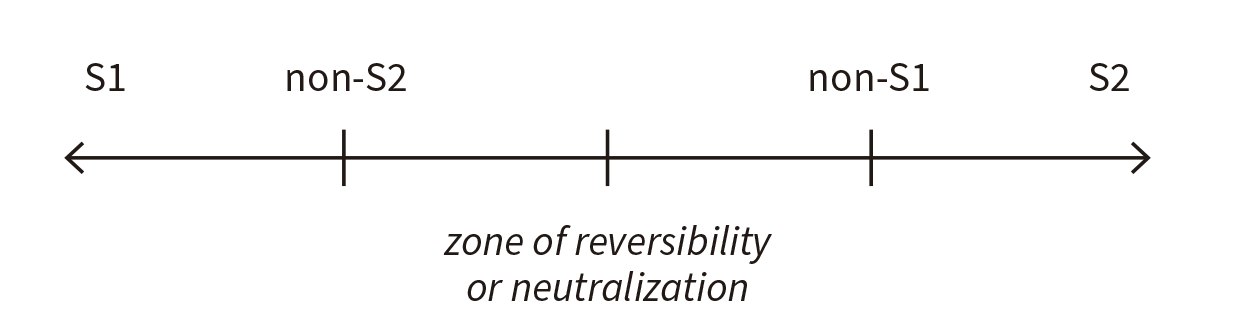
It is as though — if the image may be allowed — within an energetically dense mass multiple semantic currents (if not infinitely many) condense together. To the extent that opposites are defined, one of these currents becomes articulated and, in a certain sense, unfolded (fig. 1). The opposites now appear as the poles within which a tension develops, while the subcontraries, in the Greimasian sense, appear as zones of intermediate intensity, and the center as a zone of reversibility or neutralization of the polarities. This “one-dimensional” reading can evidently be “two-dimensionalised”, precisely as the semiotic square does by projecting and anchoring the tension, so to speak, to four corners (fig. 2). Without this yet openly bringing the complex terms into view. 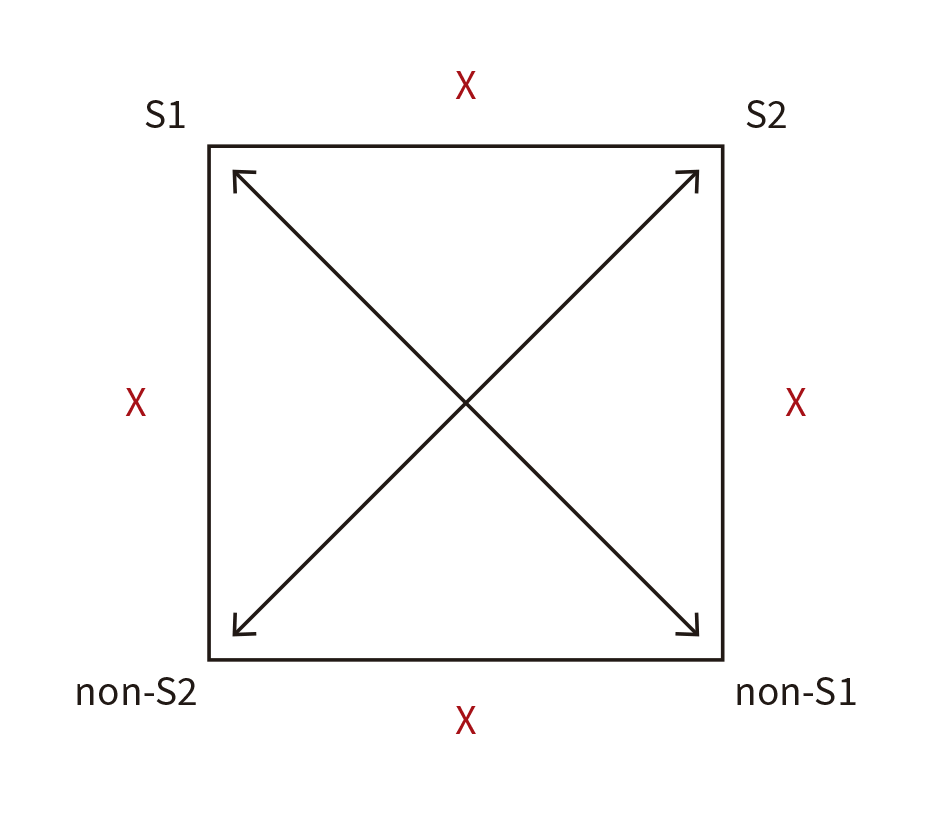
In another form, and in an attempt to restore visibility to the dynamism at work, Eric Landowski’s model (fig. 3) hypothesises that this tension circulates infinitely within the circuit itself, allowing us to appreciate the internal path16 of the captured energy and the modes of transformation that take place in the passage from one regime to another (or between specific aspects of one regime and another). 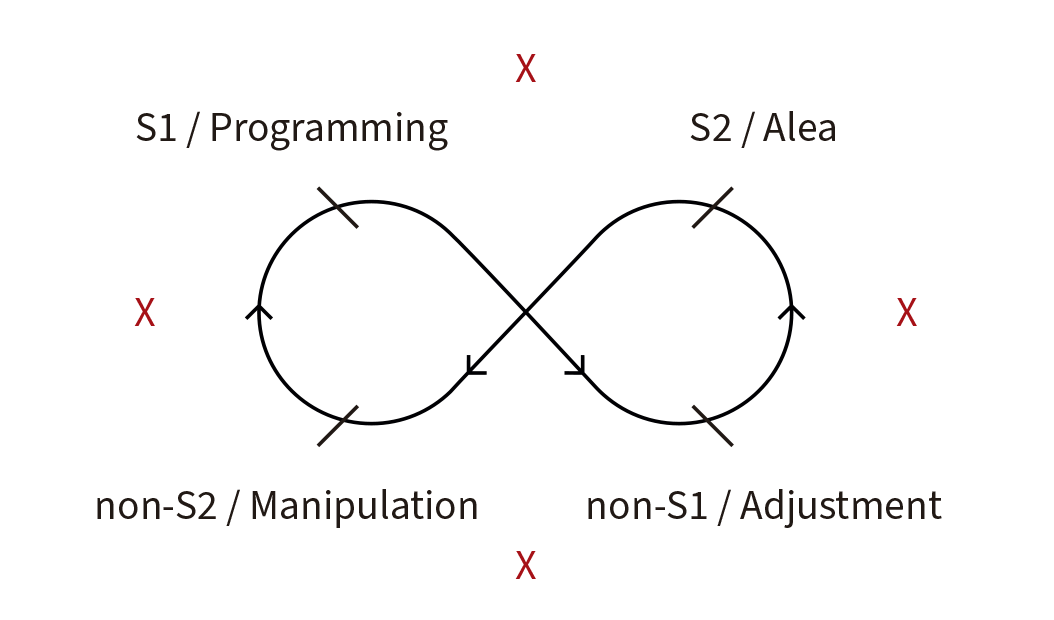
These are extremely useful methodological contributions because, beyond the theoretical criticisms raised over time against the square as a logical instrument, it — both in its basic form and in its later reworkings — has maintained an extraordinary operational force in helping us to see, trace, and articulate relations, as well as their interactions and transformations. Now, it should be noted that in Eric Landowski’s model of interaction regimes, semantic tension does not circulate through the zones of complexity. More specifically, the dynamic model passes at a distance from the point of encounter between opposites and between subcontraries (just as it graphically traverses the space that ought to correspond to the mutual intensification of complementaries, yet without lingering there). The Greimasian square, in its standard form, instead leaves open the possibility of leaping to the second level (fig. 4), though this possibility is often not fully exploited analytically or fully understood in its sociosemiotic implications. This is especially true, as we have just noted, in the case of the encounter between complementaries, a neglected form of the complex term. 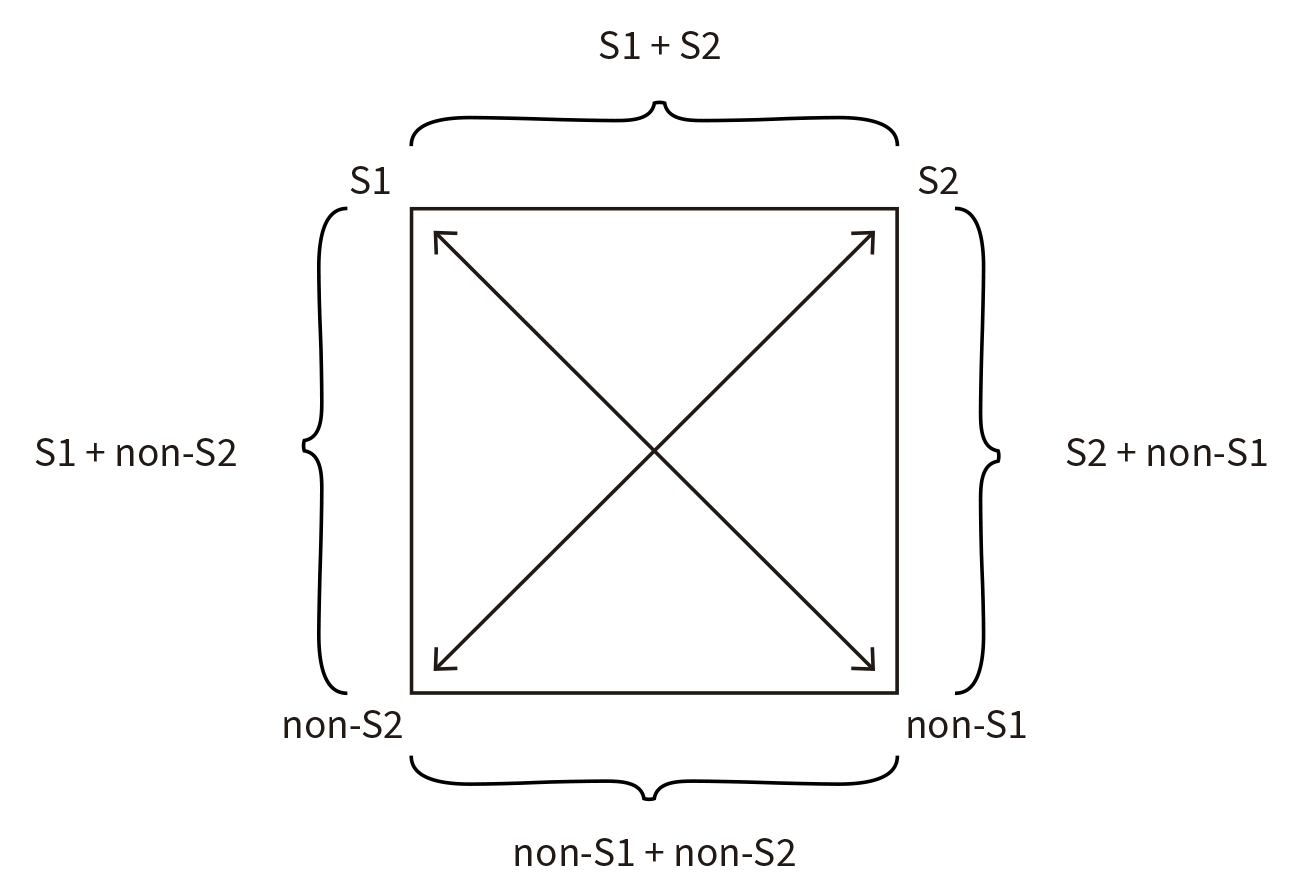
If we return to our categorical tension, which linearises semantic energy and positions contraries as the “most distant” terminals, we may observe the following. The two semantically incompatible polarities, being the result of a tension, appear less as terminals than as vanishing points (fig. 5) : the extremities of an energy that never ceases to push in two opposing directions. 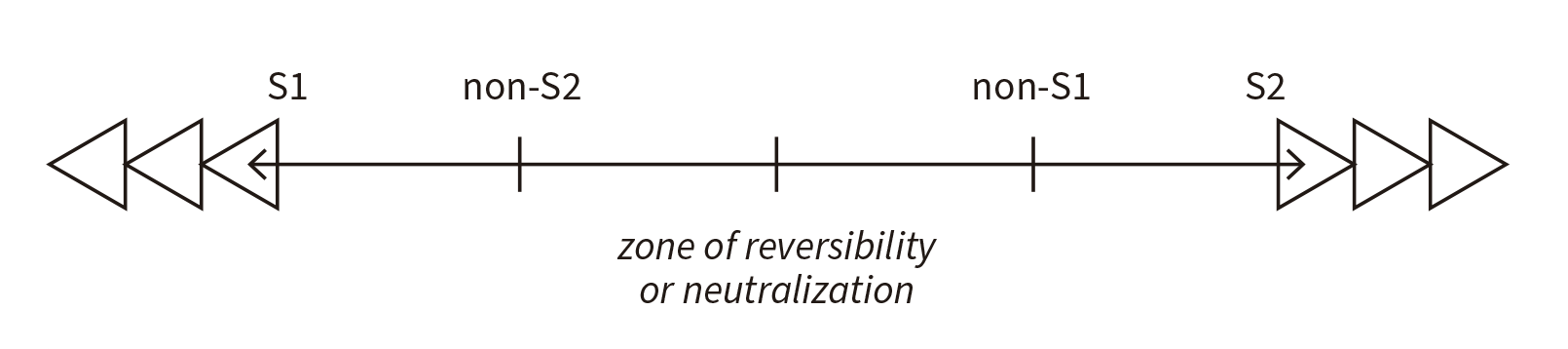
This compressed tension within categorical space tends either to break the categorical line-space or to bend it and generate a circle (fig. 6), precisely the circle within which the square itself is inscribed (fig. 8). In other words, the square may be the result of a radial explosion of categorical energy (fig. 7), which settles upon the four corners, or it may be the effect of a curvature of the extremes which, as everyday language itself puts it, through radicalisation “end up touching.” That is to say, extreme polarisation may indeed break the tension, thereby causing the relation itself to disappear and pushing semantic energy back into indistinction, into chaos ; or it may instead produce a folding that brings opposite poles into contact, causing them to “short-circuit,” thus generating another kind of crisis — one produced not by the implosion of tension, but by the emergence of a form of compatibility between incompatibles. 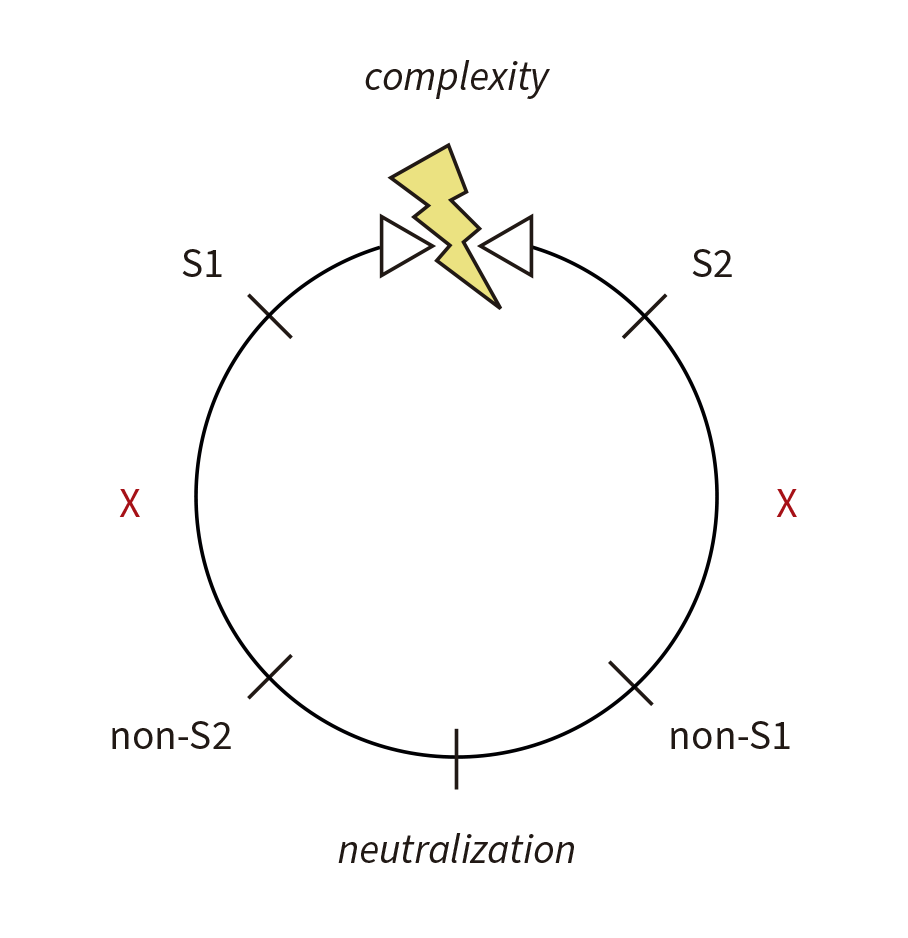
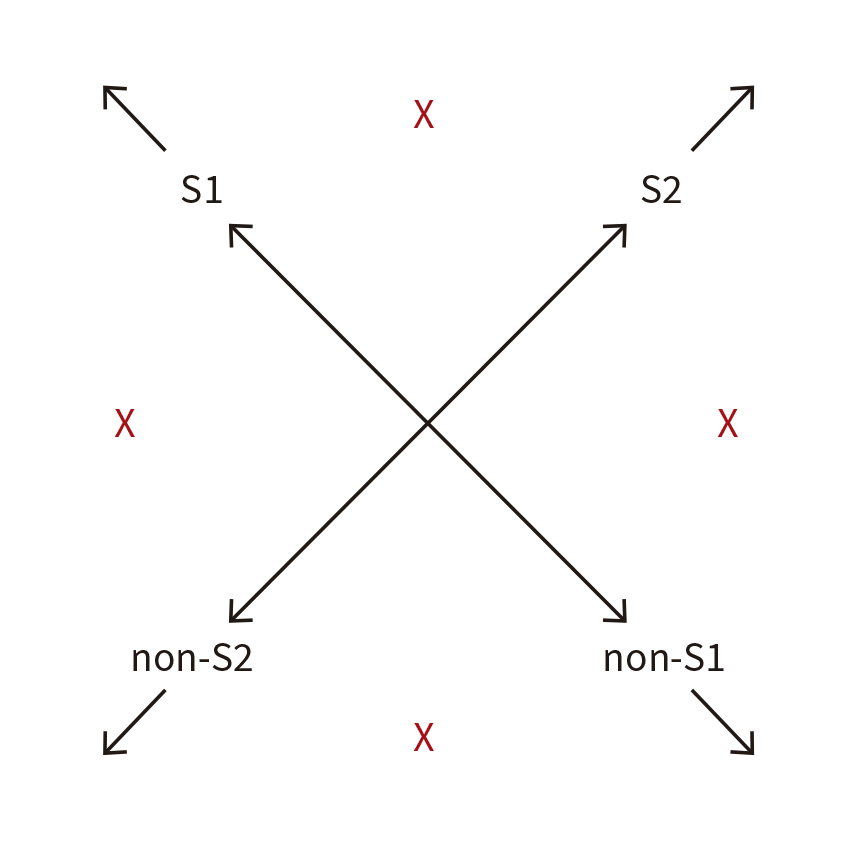
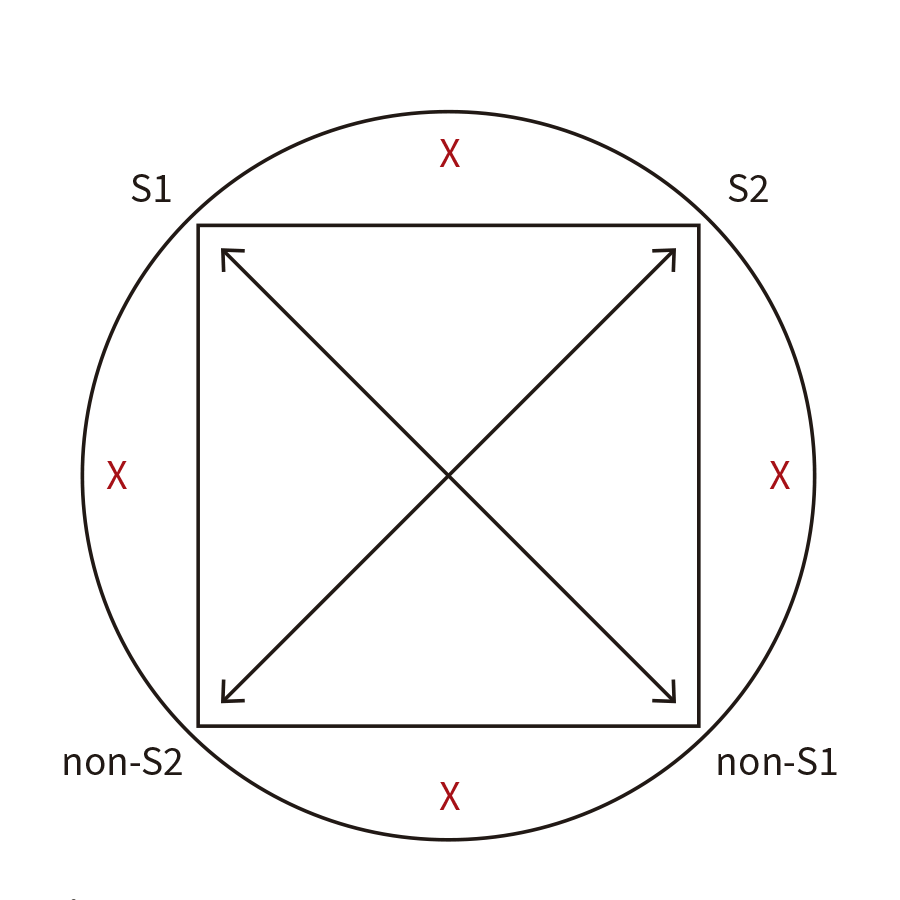
Our polarised and polarising age is precisely one in which the entire tension seems to discharge itself at the point of encounter between incompatible extremes. This, in turn, generates sociopolitically strange phenomena (one may think of how frequently the apocryphal Gramscian phrase about our age generating “monsters” is invoked today), but above all it exercises a form of dominance that bends even other logics to its own dynamic, including those with a more anthropocentric and negotiative character, such as the regimes based on adjustment between sensitivities and the manipulation of wills. As we have seen, regimes grounded in sensitivity bend toward reactivity, which, as Eric Landowski rightly shows, pushes toward forms of programming ; just as regimes grounded in motivation bend toward consensuality, which opens the way to those forms of assent characteristic of the regime of chance17. These openings are not free from a certain degree of mythology, as is evidenced by the fact that they bring into play the relationship between a space of categorical articulation that would emerge from an energetic background18 (while at the same time capturing and stabilising it in the form of tensions, positions, and transformations) and to which it would return whenever semantic tension explodes or implodes, becoming once again formless energy. This mythical line of reasoning nevertheless allows us to pose a further series of theoretical and methodological questions that may appear idle only to those who do not care about the development of a fully relationalist sensitivity — one capable of training itself to grasp not only relations themselves, but also the nuances connected to the different modes of relation between relations. Let us return to the case of a square that emerges not through the distension / articulation of a semantic tension that eventually bends back upon itself, but rather as the stabilisation of a radial tension, as though semantic material were projected toward “the four corners of the universe” from an exploding energetic core. Working within this conceptual metaphor, it is not difficult to imagine all four poles tending to move away from one another in a kind of drifting motion (fig. 7) : as in certain models of the evolution of the universe, whose parts would be mutually receding, ultimately foreshadowing the exhaustion of the energy that generated them and that they still preserve. If this were the case, it would not so much be contrariety that constitutes the “most intense” polarity, but contradiction. It is the relation between an affirmed trait and its pure negation that appears as the most radical, if not original, semantic tension (according to the famous poetic formula whereby, in the beginning, we can say only what we are not). Here too, this tension can produce not only an infinite mutual distancing, but also a genuine folding back between the contradictory semantic tensions (fig. 9). 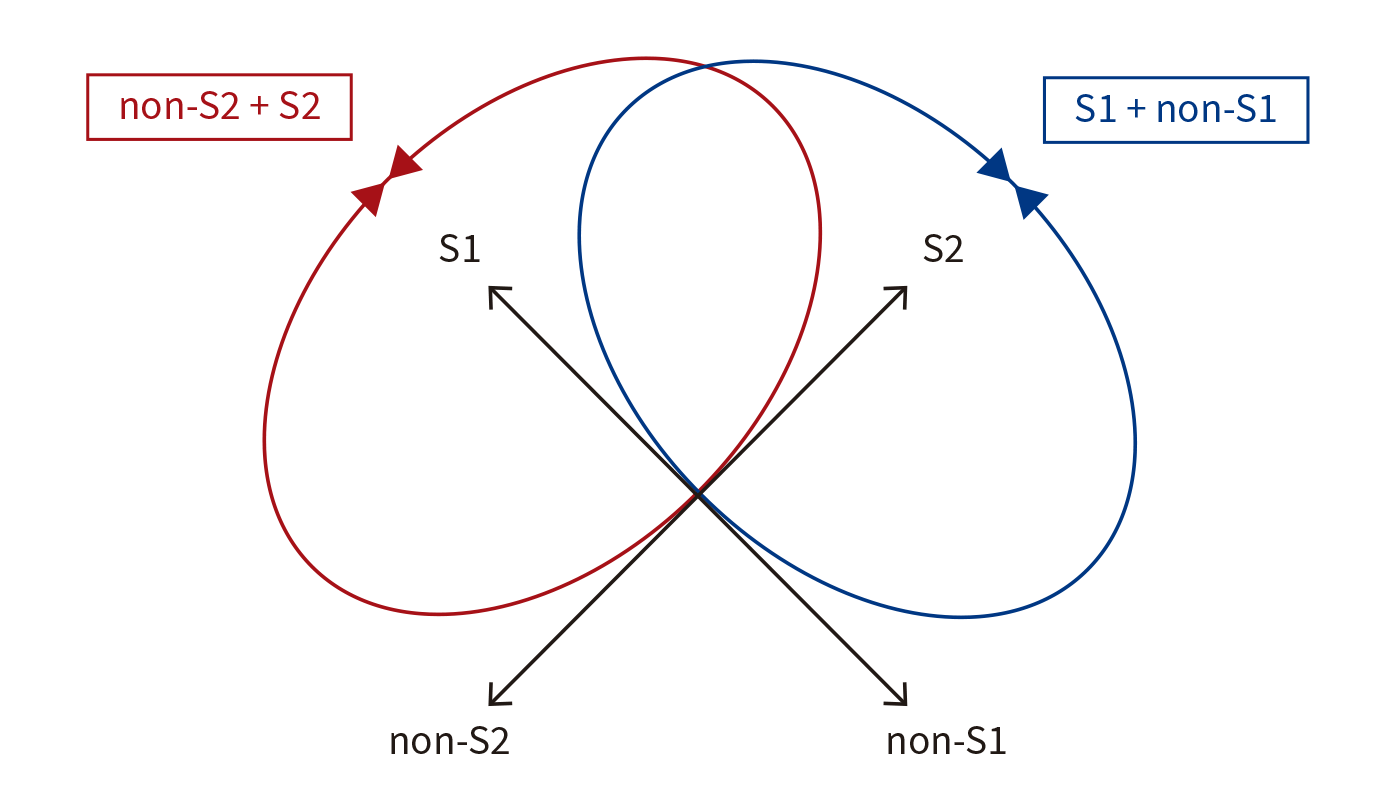
As we have shown elsewhere, contemporary forms of populism stage precisely the short circuit between a trait and its negation. This is what happens with leaders who run to govern the state by asking for consensus in order to dismantle the state itself. One may think of Trump and the attack on the “deep state,” which becomes a form of dismantling the entire administrative apparatus that sustains not only power but also the various social, healthcare, and international cooperation programs, as also demonstrated by the Pulitzer Prize-winning investigation conducted by The Washington Post. Or again, in a somehow “purer” form, the case of Milei, who openly ran for head of state in order to dismantle the Argentine state itself (including, but not limited to, the welfare state). Continuing the work on these openings, just as we began from the tension between simple terms, we may now focus on the tension between complex terms (fig. 10). Consider, for example, the tension that develops between what we normally call the complex term in the strict sense (S1 + S2) and the term that instead points toward the neutralisation of semantic difference (non-S1 + non-S2). In this case, we could speak of two different confusional logics (that of the complex and that of the neutral) entering into tension with one another. Or again, consider the tension between the combination of complementary terms : S1 + non-S2 entering into tension with S2 + non-S1. To better understand the energetic scope of such a situation, one should consider the following aspect : the combination of complementaries is already in itself an intensification of the “normal” differential tension, pushing it almost toward a fissiparous dimension (one may think of the combination masculine + non-feminine, which, socially speaking, points toward figures such as machismo, misogyny, and patriarchy, and correlates with the annihilation of women). One can then imagine how radical the tension becomes between the opposing combinations of complementaries — that is, between these complex terms already inhabited, in themselves, by a discriminating logic19. 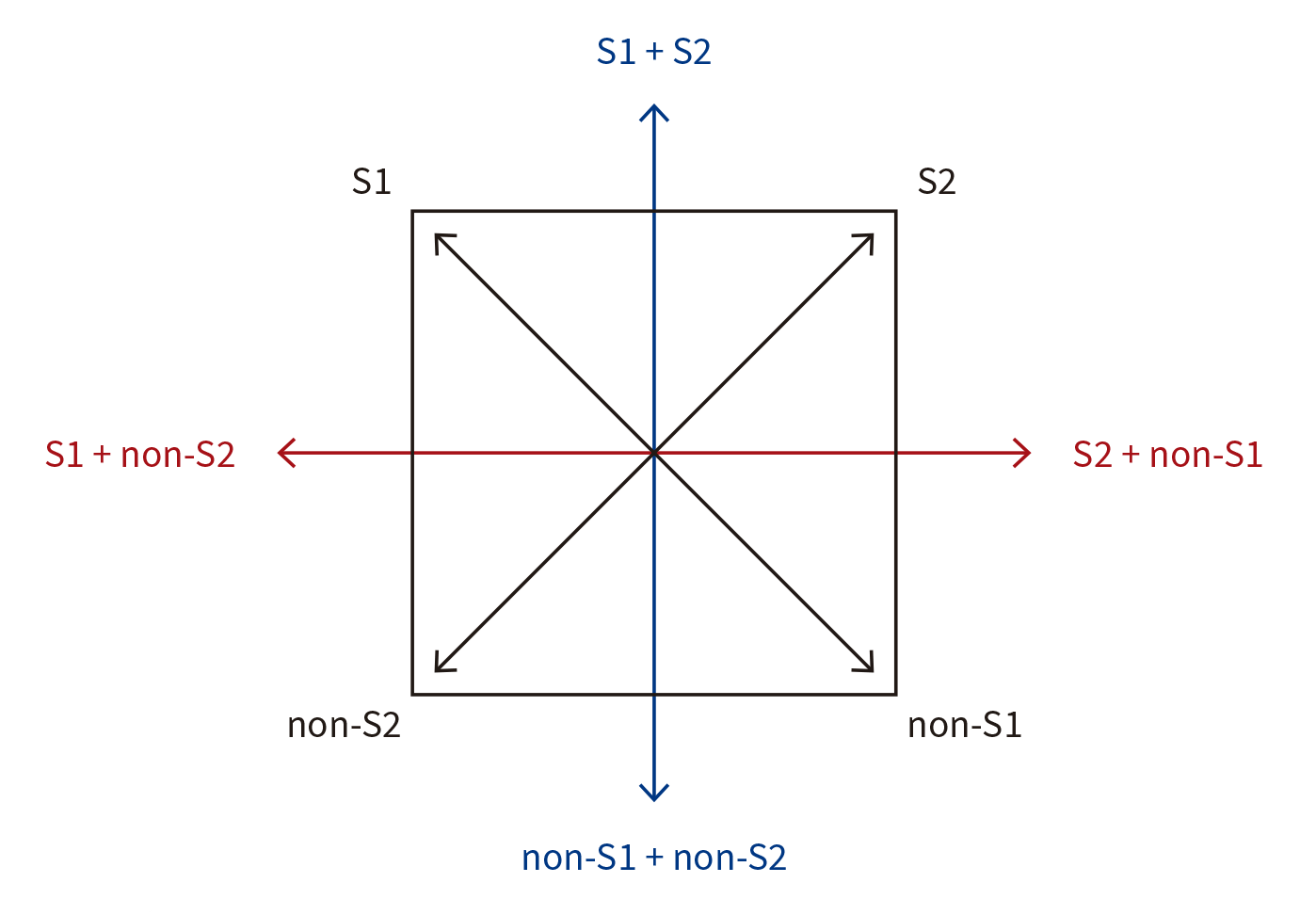
Speaking of the rhythms of unpredictability20, we have shown how these forms of meta-complexity can in turn fold back upon one another (following the same model as the folding of contradictories discussed earlier), helping us explain some of the most extreme and unprecedented phenomena of creation and creativity : short circuits raised to the nth power. More generally, these kinds of foldings lead toward a three-dimensional categorial space. No longer a line, a square, or a circle, but a genuine spherical tension. But let us stop here, since this is not what is primarily at stake in the present discussion. What we wish to emphasise is the need to visualise, perceive, and take into account the multiple tensions inhabiting the space of semiotic constraints, too flatly fixed by the square. In the concluding image (fig. 11), we present some of the tensions we have glimpsed throughout this exploratory journey. Even without visualising all the possible foldings, one can sense the dynamising scope of such openings, which, together with Landowski’s model, help explore and make productive — analytically as well — the dynamism and energy from which the articulation of differences normally “enclosed” within the semiotic square emerges, on which it lives, and which it seeks to account for. 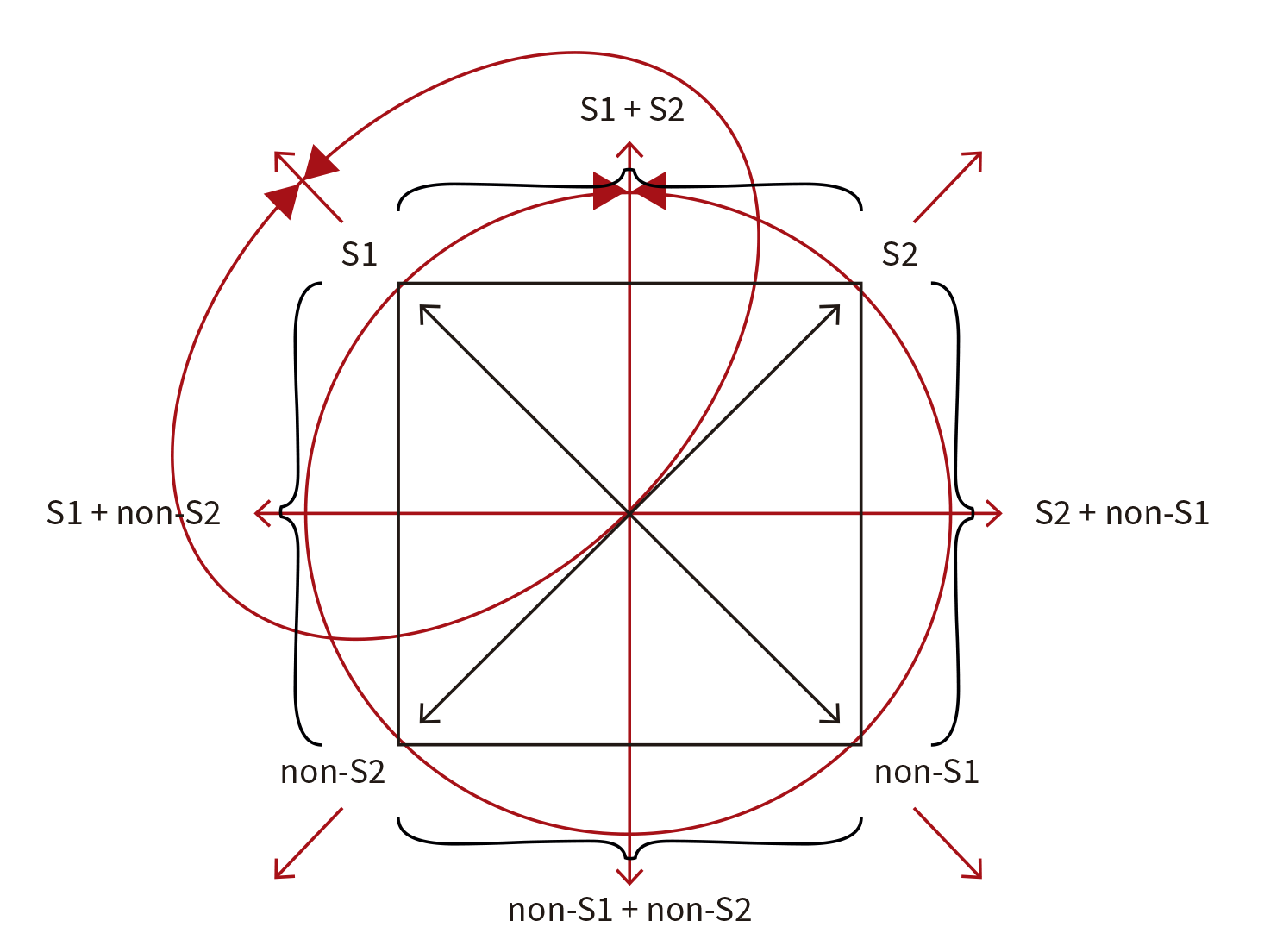
What is ultimately at stake is a double movement. On the one hand, there is the movement that, starting from the complexity of our time — that is, from the centrality of a complex term capable of holding together control and unpredictability — leads us to reopen our concepts and tools, in order to rethink them from the ground up or to think them through more deeply. On the other hand, there is the movement that allows us to see the contemporary world more clearly precisely because we have trained our theory and our sensitivity to grasp complex tensions, positions, transformations, interactions, and relations (between relations). That is, not only those involving the simple terms of the square, which we are more accustomed to handling, but which risk proving of little use or effectiveness in the face of the events we are currently experiencing. Bibliography Antonelli, Giuseppe, “Tié! Sgambetti all’algoritmo”, La Lettura, 22 marzo 2026. Graeber, David, and David Wengrow, The Dawn of Everything : A New History of Humanity, London, Allen Lane, 2021. Greimas, Algirdas J., and François Rastier, “The Interaction of Semiotic Constraints”, Yale French Studies, 41, 1968. Greimas, Algirdas J., and Joseph Courtés, Semiotics and Language. An Analytical Dictionary, Bloomington, Indiana University Press, 1983. Kahneman, Daniel, Thinking, Fast and Slow, New York, Farrar, Straus and Giroux, 2011. Landowski, Eric, Les interactions risquées, Limoges, PULIM, 2005. — “Complexifications interactionelles”, Acta Semiotica, I, 2, 2021. — Au risque du sens. Essais de socio-sémiotique IV, São Paulo, Estação das Letras e Cores, 2025. Lotman, Juri, Kul’tura i vzryv, Moscow, Gnosis, 1992. (La cultura e l’esplosione. Prevedibilità e imprevedibilità, Milano, Feltrinelli, 1993). Mulieri, Alessandro, Tecnomonarchi. Gli ideologi della nuova destra all’attacco della democrazia, Roma, Donzelli, 2025. Pieranni, Simone,“‘Furia Epica” : la Cina sta ferma ?”, Altri Orienti, Ep. 160, 6 marzo 2026. Piketty, Thomas, and Michael J. Sandel, Equality. What it is and why it matters, Cambridge, Harvard University Press, 2025. Sala, Cecilia, “L’anticristo di Peter Thiel assomiglia a quello di Carl Schmitt”, Stories, Ep. 940, 16 marzo 2026. Sedda, Franciscu, Imperfette traduzioni. Semiopolitica delle culture, Rome, Nuova Cultura, 2012. — “Re-reading Les interactions risquées. Fold and potentialities of a semiotic classic, twenty years after”, Acta Semiotica, IV, 8, 2024. — “Semiotics of Conflict : From Lotman to Semiopolitics”, in D. Monticelli, M. Maran, F. Sedda (eds.), Semiotics of Conflict. A Lotmanian Perspective, Tallinn, Tallinn University Press, 2024. — L’imprevedibile accade. Vivere e sopravvivere nel XXI secolo, Milano, Bompiani, 2025. Silver, Nate, On the Edge : The Art of Risking Everything, New York, Penguin Press, 2024. ————— Résumé : Un maximum de contrôle et un maximum d’imprévisibilité : cet essai analyse la crise du sens qui résulte de cette configuration paradoxale et propose la notion de méta-imprévisibilité comme clef interprétative. Dans une perspective sémiotique et culturologique, on distingue langages de la crise et crises des langages en montrant comment des néologismes tels que “polycrise” ou “permacrise” désignent non seulement une accumulation d’événements critiques mais aussi la difficulté structurelle à en définir la qualité. Dialoguant avec Juri Lotman et Eric Landowski, le texte explore la tension entre dimensions quantitative et qualitative, faisant apparaître comment la simultanéité des crises contemporaines, et leur interconnexion, affaiblit l’ensemble de nos capacités d’orientation (cognitives, émotives, pragmatiques). Parallèllement, à partir d’exemples tirés de la sciende, de l’économie, de la politique et des technologies digitales, l’article traite des paradoxes du contrôle, vu comme champ de conflit entre perspectives et entre acteurs, et comme relation sémio-politique oscillant entre pratiques démocratiques et dérives autoritaires. Une attention particulière est dédiée aux technologies algoritmiques et à l’intelligence artificielle, qui amplifient à la fois les capacités prédictives et les conditions d’indétermination, faisant de l’erreur et de l’imprévu des éléments structurels des processus décisionnels. La partie finale, qui vise à approfondir l’approche théorique du thème de la complexité, tente d’expliciter les interrogations, explorations et nouveaux développements que suscite notre condition contemporaine touchant la théorie sémiotique elle-même, sollicitant par là notre sensibilité analytique aussi bien que sociale. Mots clefs : algorithme, complexité, contrôle, crise, imprévisibilité, Palantir, Peter Thiel. Resumo : O ensaio analisa a configuração paradoxal da contemporaneidade, marcada pela coexistência de máximo controle e máxima imprevisibilidade, propondo a noção de meta-imprevisibilidade como chave interpretativa da crise do sentido. Numa perspectiva semiótica e culturológica, distingue entre linguagens da crise e crise das linguagens, mostrando como neologismos como “policrise” e “permacrise” indicam não apenas um acúmulo de eventos críticos, mas também uma dificuldade estrutural em definir a sua qualidade. Em diálogo com Iuri Lotman e Eric Landowski, o texto explora a tensão entre a dimensão quantitativa e qualitativa da crise, evidenciando como a simultaneidade e a interconexão das crises contemporâneas enfraquecem as capacidades cognitivas, emocionais e pragmáticas de orientação. Paralelamente, o contributo aborda os paradoxos do controle, entendido como um campo de conflito entre perspectivas e atores. Através de exemplos provenientes da ciência, da economia, da política e das tecnologias digitais, o controle emerge como uma relação semiopolítica oscilando entre práticas democráticas e derivações autoritárias. Particular atenção é dedicada às tecnologias algorítmicas e à inteligência artificial, que amplificam simultaneamente as capacidades preditivas e as condições de indeterminação, tornando o erro e o imprevisto elementos estruturais dos processos decisórios. Por fim, procuraremos abrir e aprofundar a reflexão teórica em torno do tema da complexidade. Também para mostrar como esta condição contemporânea favorece questões, explorações e implementações relativas à própria teoria semiótica, capazes ao mesmo tempo de alimentar a nossa sensibilidade analítica e social. Abstract : The essay examines the paradoxical configuration of contemporaneity, marked by the coexistence of maximum control and maximum unpredictability, proposing the notion of meta-unpredictability as a key to interpreting the current crisis of meaning. From a semiotic and culturological perspective, it distinguishes between languages of crisis and the crisis of languages, showing how neologisms such as “polycrisis” and “permacrisis” signal not only an accumulation of critical events, but also a structural difficulty in defining their very quality. In dialogue with Juri Lotman and Eric Landowski, the paper explores the tension between quantitative and qualitative dimensions of crisis, highlighting how the simultaneity and interconnection of contemporary crises weaken cognitive, emotional, and pragmatic capacities of orientation. At the same time, the essay addresses the paradoxes of control, understood as a field of conflict among perspectives and actors. Drawing on examples from science, economics, politics, and digital technologies, control emerges as a semiopolitical relation oscillating between democratic practices and authoritarian drifts. Particular attention is paid to algorithmic technologies and artificial intelligence, which simultaneously amplify predictive capacities and conditions of indeterminacy, making error and unpredictability structural elements of decision-making processes. Finally, we will attempt to open up and deepen the theoretical discussion surrounding the theme of complexity. This will also allow us to see how the contemporary condition fosters questions, explorations, and developments concerning semiotic theory itself, capable at once of nourishing both our analytical and our social sensitivity. Riassunto : Il saggio analizza la configurazione paradossale della contemporaneità, segnata dalla compresenza di massimo controllo e massima imprevedibilità, proponendo la nozione di meta-imprevedibilità come chiave interpretativa della crisi del senso. In una prospettiva semiotica e culturologica, distingue tra linguaggi della crisi e crisi dei linguaggi, mostrando come neologismi quali “policrisi” e “permacrisi” indichino non solo un accumulo di eventi critici, ma una difficoltà strutturale nel definirne la qualità. In dialogo con Juri Lotman e Eric Landowski, il testo esplora la tensione tra dimensione quantitativa e qualitativa della crisi, evidenziando come la simultaneità e l’interconnessione delle crisi contemporanee indeboliscano le capacità cognitive, emotive e pragmatiche di orientamento. Parallelamente, il contributo affronta i paradossi del controllo, inteso come campo di conflitto tra prospettive e attori. Attraverso esempi tratti da scienza, economia, politica e tecnologie digitali, il controllo emerge come relazione semiopolitica oscillante tra pratiche democratiche e derive autoritarie. Particolare attenzione è dedicata alle tecnologie algoritmiche e all’intelligenza artificiale, che amplificano insieme capacità predittive e condizioni di indeterminatezza, rendendo errore e imprevisto elementi strutturali dei processi decisionali. Infine, proveremo ad aprire ed approfondire il ragionamento teorico attorno al tema della complessità. Anche per vedere come questa condizione contemporanea favorisce domande, esplorazioni e implementazioni relative alla stessa teoria semiotica, capaci al contempo di nutrire la nostra sensibilità analitica e sociale. Auteurs cités : David Graeber, Algirdas J. Greimas, Daniel Kahneman, Eric Landowski, Juri Lotman. Plan Introduction1. Meta-Unpredictability2. The Paradoxes of Control3. Knotting Together Control and Unpredictability4. Theoretical Openings on Complexity |