In Vivo
|
Interacting with Materiality : Anna Maria Maiolino’s Worlds Invention Ana Claudia de Oliveira São Paulo, PUCSP : PPGCOS, CPS Acta Semiotica, VI, 10, 2026
|
|
|
Anna Maria Maiolino’s work, as presented in the exhibition entitled, I Am Here, held in Paris at the Musée Picasso during the summer of 2025, constitutes an intense, inventive process in which materiality is the source of constant exploration. At stake are earth, clay, cement, plaster, wood, paper, graphite, India ink, watercolor, thread, metal, and light. Her invented objects spring from technical methods that are part of the process which brings them into existence and makes them perceptible. Long before we can see, hear, touch, feel, and appreciate a given object, its existence springs from the raw matter from which it is made. In Maiolino’s series of experiments, nothing is readymade, but everything displays potential evolution. Her use of materials is expressed through drawings, sculpture, photography, performance, architecture (her performances and installations are developed in three-dimensional space) and video pieces in which light, sounds, voices relate to the visual and kinetic dimensions. Not to mention literary artworks that deploy typographical devices across the two-dimensionality of paper, canvas, woodcuts or books, as well as many other constructs that emphasise the primacy of formants, these basic constituents (shape, colour, location, and materiality) that articulate the effects of meaning of an object. Materiality has been the characteristic feature of Maiolino’s production from the start and it still is today, justifying the aesthesic perspective adopted here in order to account for the mode of presence and meaning of the objects she brings to life. Who is this “I” who is “here,” here and now ? The layout of the rooms of the Paris exhibition is an invitation to wander among her various technical methods and the organic plasticity (as distinct from figurativity) of her works, which embody explorations arising from multiple encounters and triggers. The museum-goer becomes a conversational partner, addressed informally as “you” (tu), as he or she walks around in an effort to become familiar with Maiolino’s creations. Guided by the active, speaking “I” who offers systematic clues, this “you” enters into the “I-you here / now” perspective of her work, thereby becoming a co-participant in the construction of meaning. Throughout the exhibition, the beholder is guided by the unblinking eye of Maiolino’s video, an eye that is everywhere, from floor to ceiling, from walls to windows : this figurative “I” urges “you” to remain vigilant at all times. By way of introduction, the artist presents herself to the European public. She does so through a woodcut titled Anna. By sculpting and carving the gestures of her everyday life — cutting, furrowing, fissuring the wood with knives and gouges — Maiolino exhibits and names herself. In so doing, she surprises us by including speech in interaction with the carved drawing. Verbal and visual are interwoven in a syncretic process that combines languages in an interplay between black and white, dark and light on the surface of the paper. 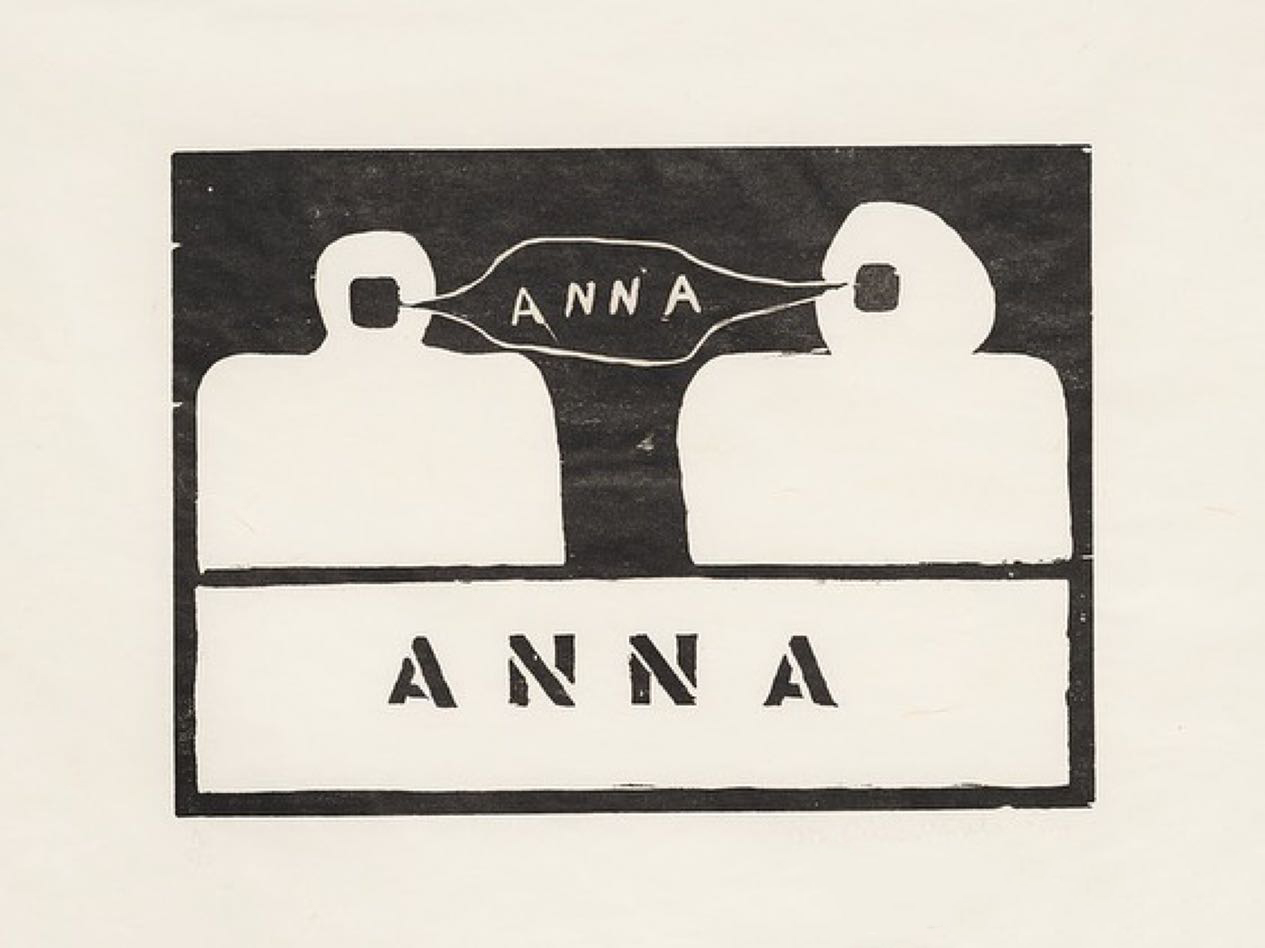
The blackness of the background contrasts intensely with the whiteness of the two figures, placed in a field divided into two spaces, upper and lower. Therein lies the tale of Maiolino’s construction of identity. What, then, do these woodcut bodies — male or female, or both, or one and the other, or one for the other, perceived only through the outline of head and torso — have to say ? In the upper space, with its black background, the two white bodies are indicated by two rectangular blocks with rounded heads pierced with just a little rectangular hole representing their facial features ; between these two beings, a mouth-like shape might suggest a shared pair of lips pronouncing a name etched in slender, white printed letters — slightly slanted, sans-serifed — as though the sound was uttered jointly by the two partners. The same letters, AN - NA, are thus spoken simultaneously and symmetrically by each mouth : the visual, phonic and spatial conjunction of those letters say ANNA, the name they assign to a third person. Visually spelled out across the topological surface and uttered by both figures, they come together to impart life to ANNA. In the lower space, composed of a white rectangle, the name loses the italic slant that suggested conversation between the two bodies, thereby assuming an independent existence. Going further, perhaps this spatial arrangement is that of ANNA’s existence, arising from or based on the two bodies, in so far as these four black letters are arrayed in the center of the flat surface. Their graphic weight is suggested by diagonal white gaps imparting an upward and downward thrust to the two As and two Ns, whose stems strongly convey the vertical direction towards top and bottom. Such lines project the name across the entire white surface, traversed by each of the four duplicated letters, their repetition creating an expansion of ANNA upward, downward, and sideways. When we look at the whole lower part — occupied, like the spoken name, by ANNA’s presence in the world — we notice that this section corresponds to the extension of the lower limbs of the bodies in the upper part, suggesting that ANNA achieves her domination through and with them. This work is closely related to another woodcut, Schhhiii. Together these prints reveal the importance of woodcuts in the development of Maiolino’s artistic expression. 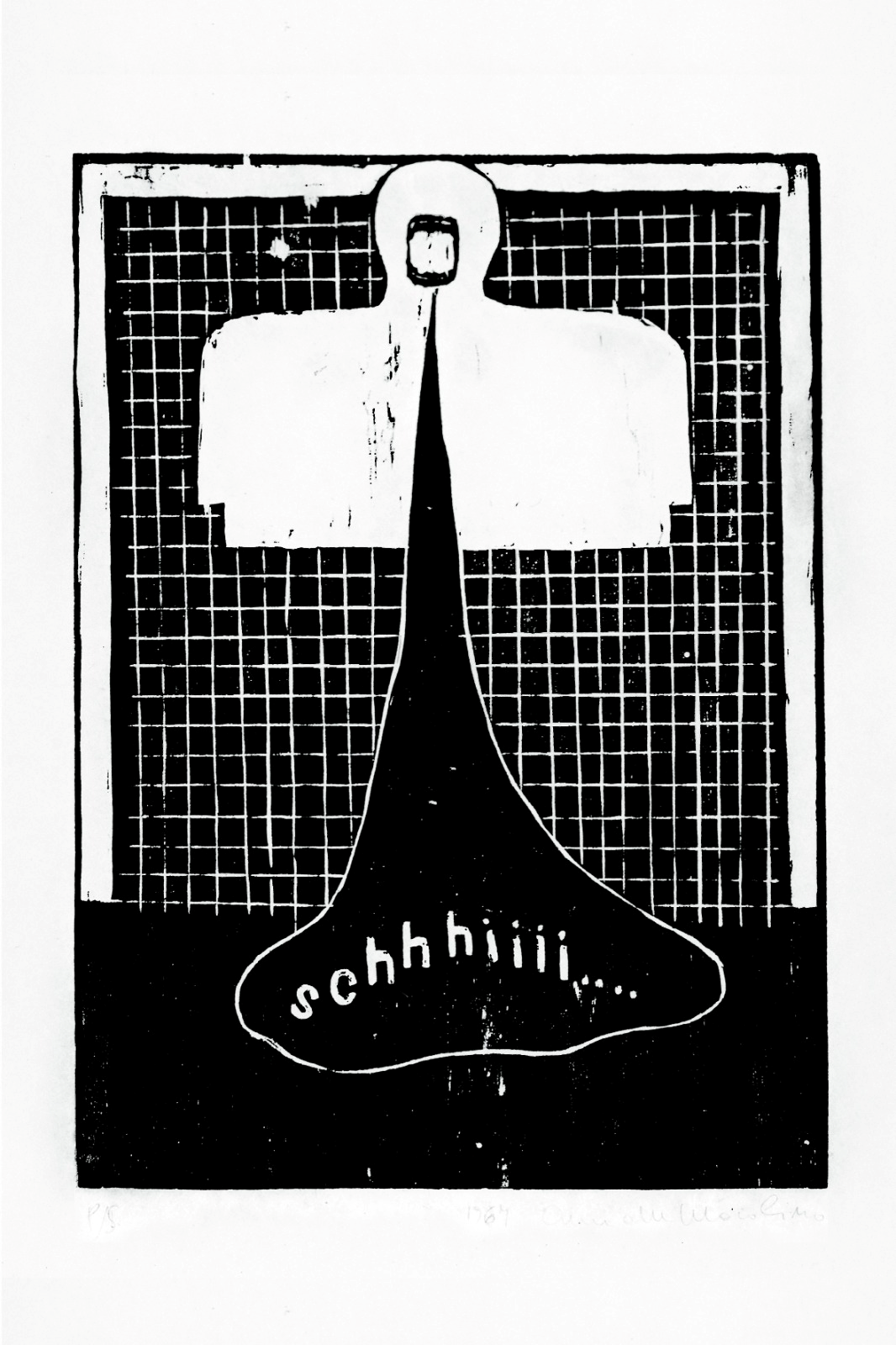
In Schhhiii a figure is set against a black ground covered by a pattern of white orthogonal lines, and issues an onomatopoeic sound from deep within. The powerful exhalation projects the sound from center top, where head and sensory organs are located, towards the bottom. The black liquid form descends in a line that widens until it reaches the black rectangular base below, where it lies. As though contained in a bag, the exhalation spreads as it falls downward, taking a form visible to the beholder facing the work. Inside the bag, slender white letters occupy the surface in a rhythm imparted by the “s,” which, with its own thrust, knocks the “c,” which reaches the vertical stem of “h.” From there, “sch” steadily rises through two more “h”s until the phonic unit slightly descends into the four repeated verticals of the vowel “i,” followed by a comma. Four descending dots suggest short pause. Are they reinforcing the final period or, on the contrary, are they the mark of ellipsis ? Ellipsis indicates something implicit, incomplete, or omitted, unwritten. Here continuity is affirmed through the indicative expression of the sound, acknowledged by the thrust outward from within. This utterance of schhhiii might even be understood as something implicit, something just beginning to be made explicit, something to be continued in other works. At this point, the meaning of the grid pattern on which the speaking body is placed becomes tangible : it is one of Maiolino’s many expressive manners of situating oneself in a world based on everyday actions, which are constitutive of her identity and the source of her vitality. |
|
|
From strolling around sculpture to visible and tactile penetration 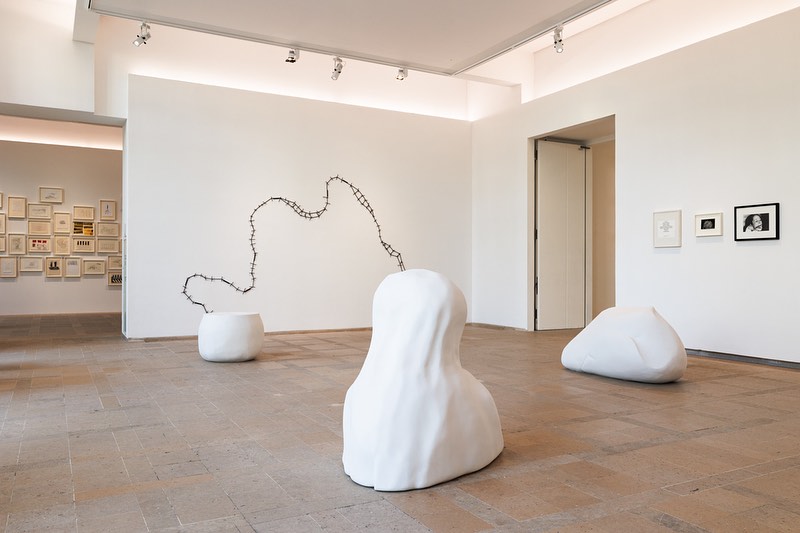
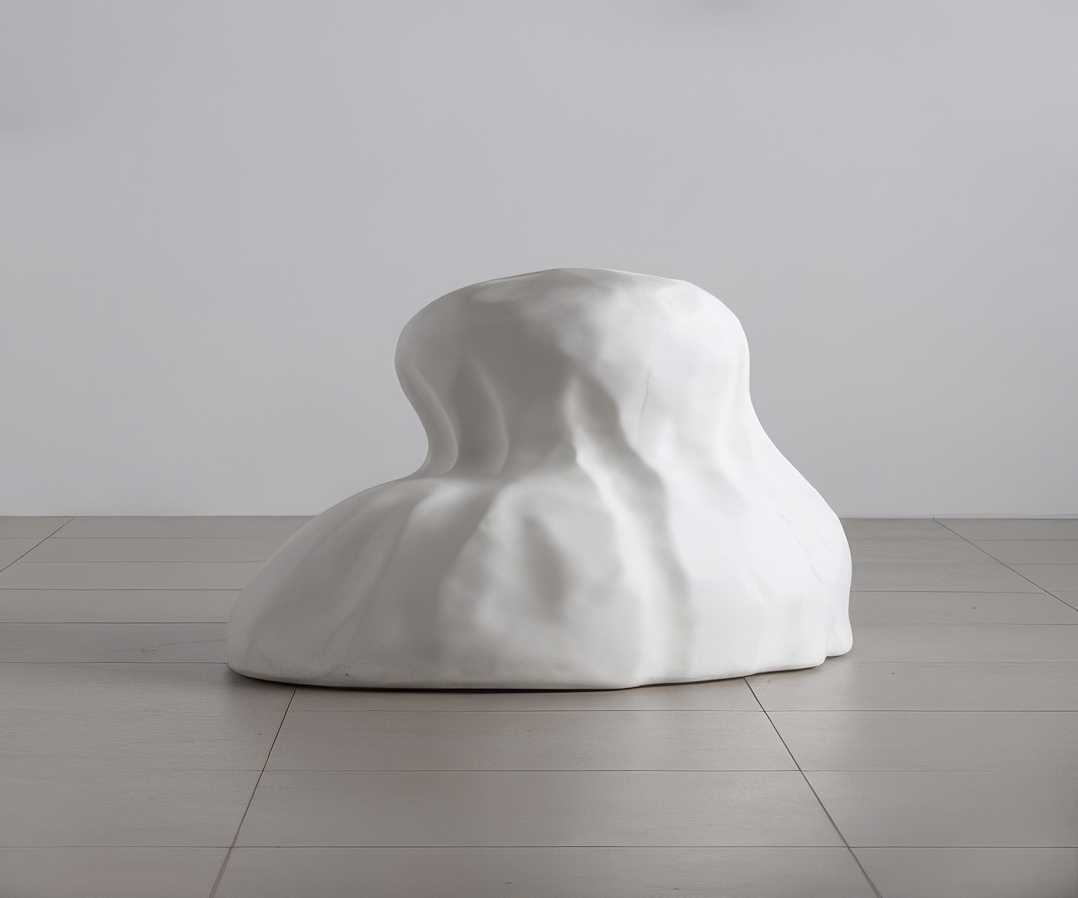
We walk around three Hilomorfos — a series of plaster sculptures —, seeing them from full body height. We look at them from above, and can walk among them. We then move from these pieces to four other sculptures. At first sight, they are not set on traditional bases or pedestals. We can lean over them, head and chest. They stand on four black metallic uprights that create a kind of table, on which each piece is set, placed a certain distance from one another, spurring us to approach each cube. Studying each as we make a complete 360° tour, we shift from an exterior space to an interior one : only then do we enter each of the worlds created by the series Da Terra. Errância Poética (From the Earth. Poetic Wanderings), lowering our gaze to penetrate them, piercing and hollowing the cement filler. The initial fluidity of that self-compacting grout (designed to fill empty space) enables the mixture to carve its own path, either filling voids or leaving them apparent, which means the final result is always surprising. 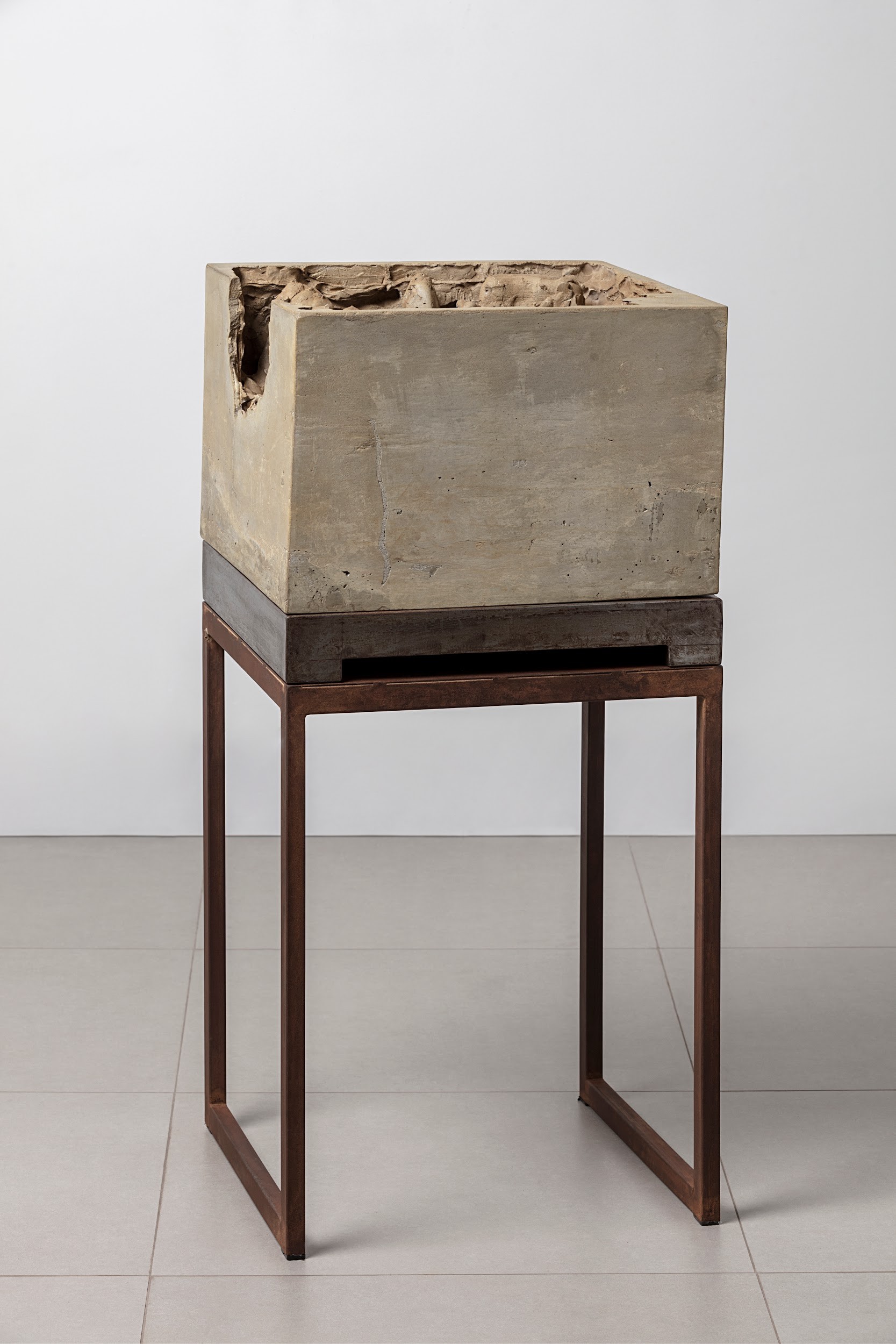
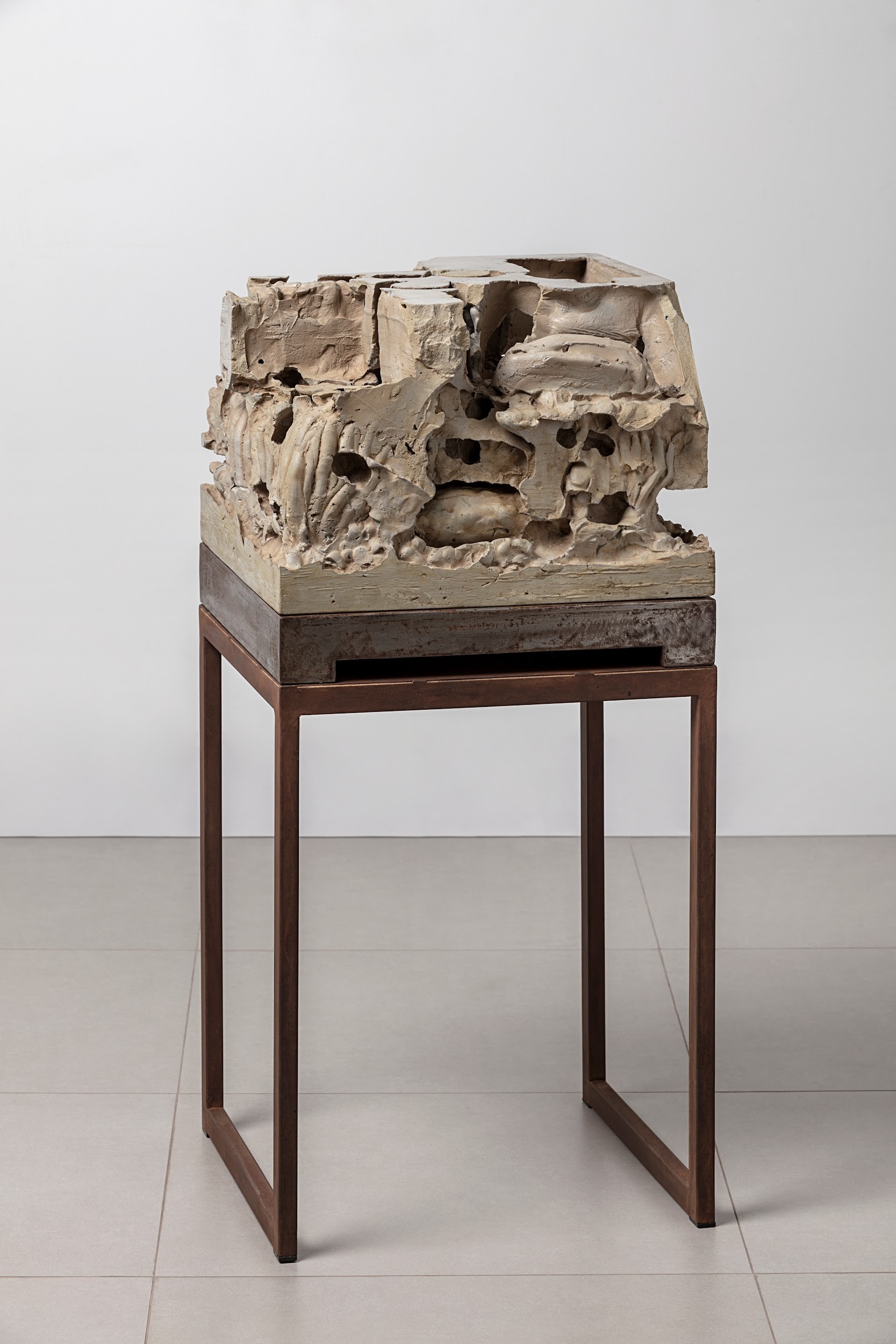
4 sculptures made of cement grout on a black metal table. Source : Estudio Maiolino. Unlike the plaster Hilomorfos, which induce us to admire the initial result of sculpture made from casts, these works plunge us into a form of underground landscape. When being made, rectangular formworks of wood were bolted to their sides, retaining the liquid grout until it became a solid block. During the mutation from a liquid state to a solid one, the figurative result of the transformation remains unknown. Only once solidified does the work display craters that reveal underground landscapes : an extraordinary vision of the earth’s entrails. Being unable to reflect the sweeping totality of the depths of the earth, each of these sculptures offers an incomplete vision. From this submerged space our imagination freely ventures among dark abysses. And from there we begin to follow the snaking line of the series titled Incompletude. Once again, fragmentation will open up a new pathway. |
|
|
The metonymic semantics of incompleteness 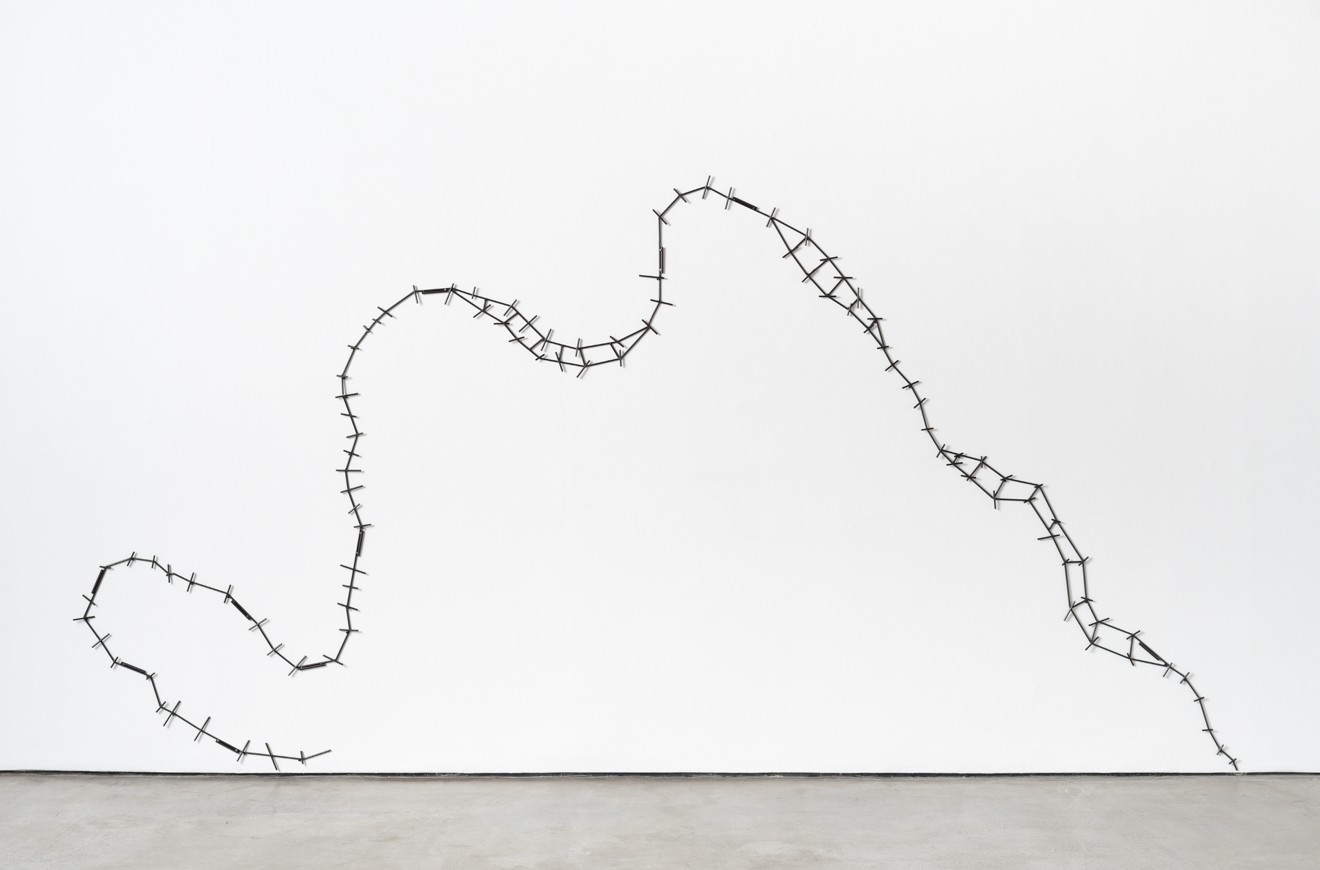
A black metallic line emerges from a point on a white wall, to the left, as though it sprang from nowhere. The line rises a certain distance leftward, crossed by little wires of the same material, creating a play of intersections, pinning its path along the wall until it reaches a tip. In a somersault effect, the line flips and returns parallel to its original path. Reaching the level of its point of departure, it rises vertically, the little cross-wires looking like degree-marks recording its climb. After making a slight turn, the line splits into two, as though now reinforced by a parallel line that supports its own upward movement. From there it begins to descend, still twinned by a parallel line that falls until the two lines merge into a single one at the right-hand base, heading towards the floor. Does the line end there, or does it continue underground ? As it approaches the ground, our eyes can’t see if the line penetrates it ; ignorant of the rest of its path, we remain in a state of uncertainty. This path indicates a trajectory that also flaunts incompleteness, if in a different material. Once again, Maiolino’s explorations are rendered semiotically relevant, both in terms of plasticity and figurativity, by the process of showing part of a whole. When we are shown one part, the question arises as to whether or not there exist other, invisible parts beyond these visible but incomplete, interrupted, trajectories. Plus the additional question : where is this constantly flaunted incompleteness taking us ? Excess as signifier Along the path of the exhibition are works from different series, including examples of Maiolino’s codified, figurative drawings in acrylic ink on paper, two wall sculptures in pigmented cement, three photographs (featuring the perfect shape of an egg), a photo of the artist’s mother, Maiolino herself and her daughter connected by a string, and a photo of hands placed on a head. 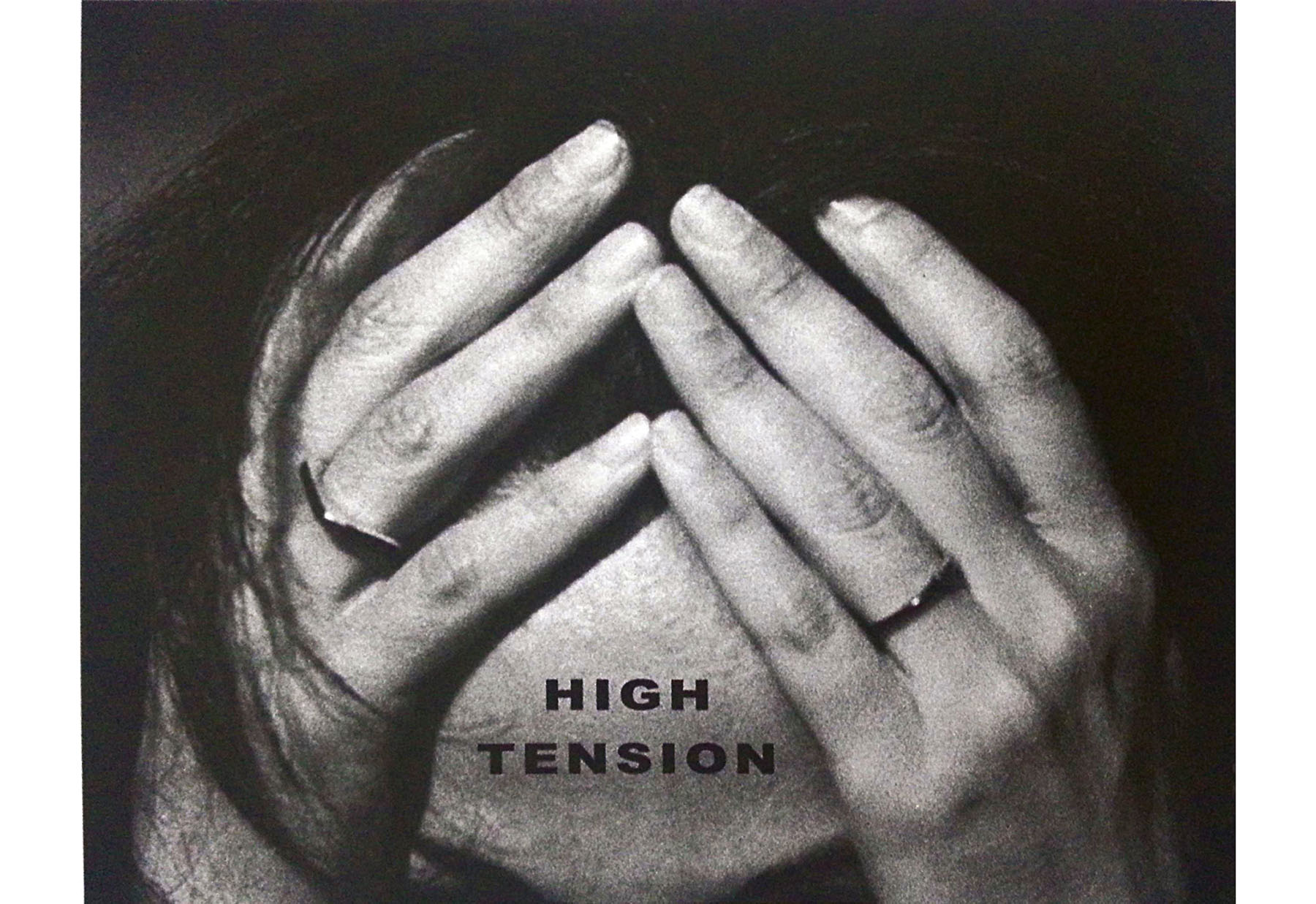
High Tension, from the Fotopoemação series, shows us the exasperated tension of a subject living in the constant incompleteness of her own quest for meaning in art and in the world. Through a form of contagion, we feel that such an incompleteness is a way of sensing our own being-in-the world. This endless quest continues with 86 of the 200 drawings (mostly shown for the first time) from the series Tempestade de ideais (Brainstorm), which concretise the idea of there being no end to Maiolino’s infinite projects. On the floor, a TV screen endlessly loops through video pieces : In-Out (Antropofagia) (1973-74), Ad hoc (1982), Um momento por favor (One moment, please, 1999/2004), and é o que é (it is what it is, 2019). This long-term series began with Maiolino’s first super-8 film, In-Out, which she wrote, directed, and edited. The camera follows no linear logic, sometimes focusing on a man’s mouth, sometimes on a woman’s, while the lips change color depending on mood and mental state. As they open and close, the lips reveal the white line of teeth and display the muscular movements around the mouth and cheekbones, indicating different thymic states experienced with dysphoric intensity. Live voices projected by works from different time-frames resonate in the space, producing a cacophony of effects generated by an excess of overall dysphoria, which emanates from everything we hear and see when we move. The drawings include a set of eight works stitched on paper, titled Indicios (Indexes). 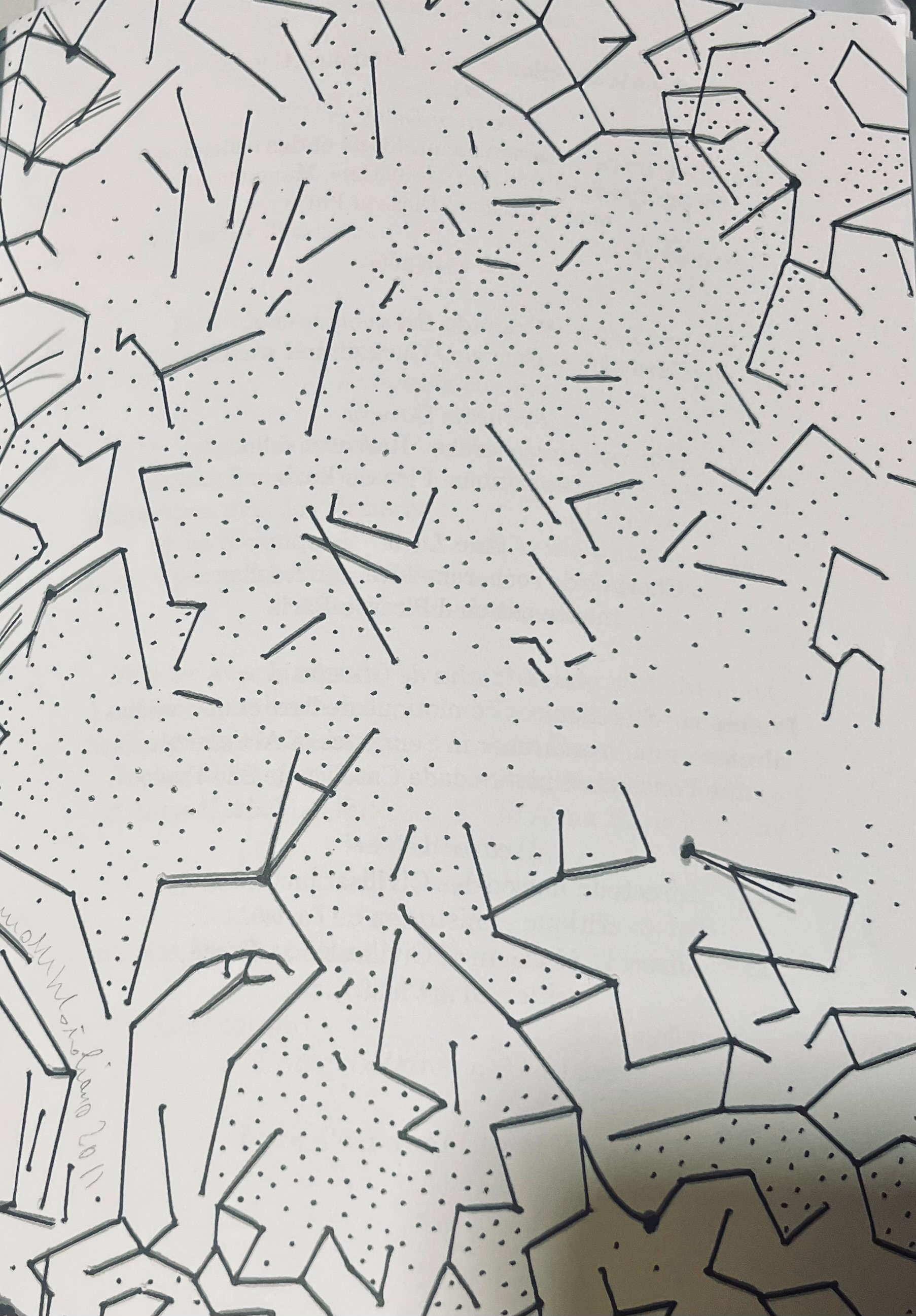
Source : Estudio Maiolino. A threaded needle pierces the flat surface of a sheet of paper, so that the design can be seen on the back as well as the front, thereby inducing the beholder to circulate in order to view the other face of the drawing. This type of displacement, designed to grasp the totality of a work, reminds us of the way we perceived the Hilomorfos and the sculptures of grout filler. 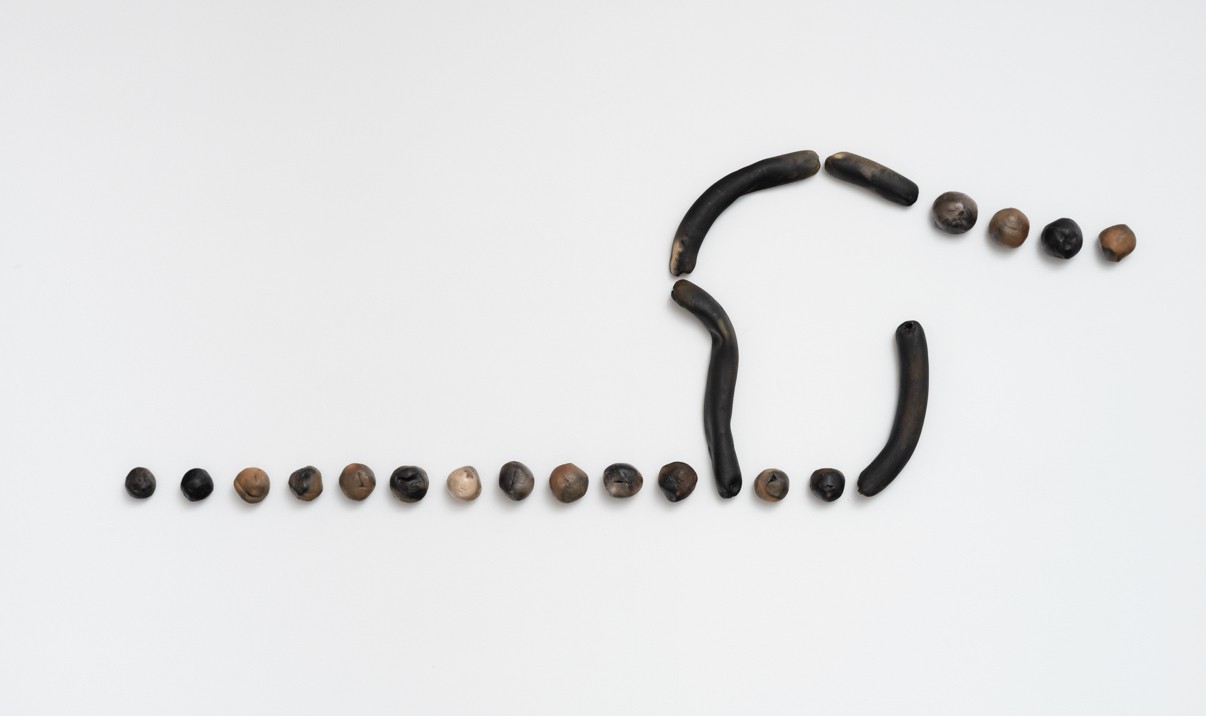
Ceramics raku. Source : Studio Maiolino. A line is composed of small ceramic balls, spotted with sober colors, made in the raku technique : once removed from the kiln, items are placed in a closed receptacle filled with dried straw that gives off smoke on contact with hot ceramic ; this smoke colors their surface. In the exhibition, a line of raku-ware balls begins along the inner left side. The sequence continues beyond the halfway mark, where a longer raku shape intercepts and turns it upward while two other raku balls extend the original line, ending in a second curved shape that repeats the upward thrust. Meanwhile, the upper tip of the first curve is extended by four raku balls, again discontinuous. Beginning and end are thus presented as dotted lines of raku-ware, which once again evoke the idea of interruption, of incompleteness. In this way, Linhas e Pontos renews Maiolino’s relentless quest for unexplored processes, making material visible in the form of her works. As it makes material visible, the created form liberates the matter’s potential. What was only a virtual competence of the matter comes to be realised through the performance of the artist. This is how Maiolino’s creative acts appear as caught between cognitive competence, aesthesic feeling and performance. What seems like a conclusion to all these experiments is a vast intertextuality that plays out in interdiscursive convergences, with a proliferation of meanings that lead the beholder to the brink of senselessness. Yet these distinct series, whether separately or combined, display similarities of theme, plasticity and figurativeness, and method, all explored in various materials. They assert that art is made from everything that exists in the world. In making this claim, Maiolono’s semiotic practices deploy the “I” of this show’s I am Here and makes us feel that discontinuity, interruption, incompletion express what we all experience, that we share this same social environment of unfinished, incomplete, processes. On the other hand, it is impossible not to realise that this incompleteness opens our horizon to constant renewal. A resignifying stroll through Terra Modelada Marc, si possible réduire le format de la fig. 9 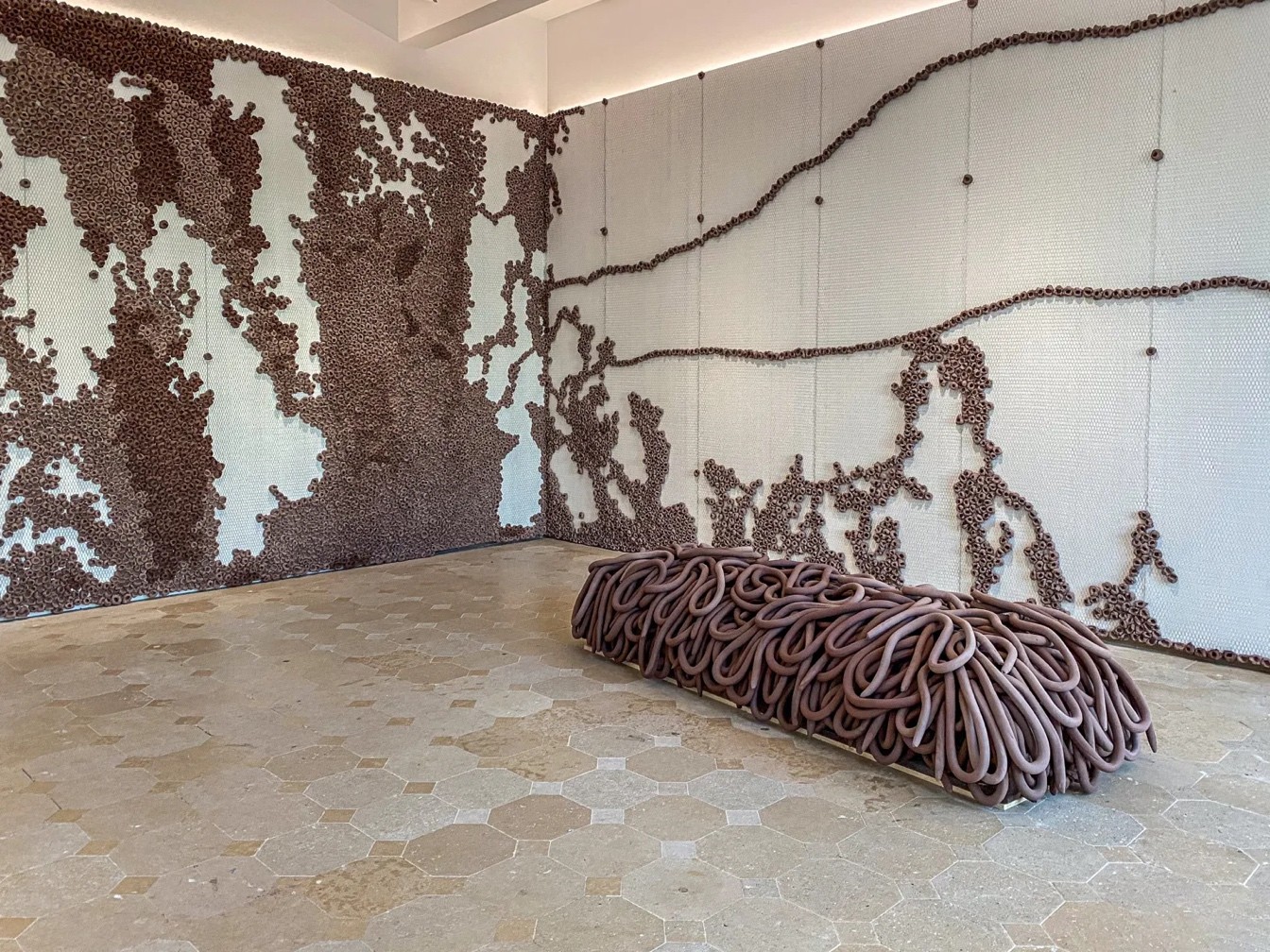
Entering Terra Modelada (Modeled Earth) — a realm thoroughly distinct from the previous rooms — we become involved in a chromatic play of brownish hues set against white. The beholder is drawn to a three-walled structure on which two tons of unfired clay have been modeled in situ. Enveloped by this environment, we pause in order to reconstruct the landscapes within this landscape. This series of installations of clay works in the making, begun in the 1990s, is composed of a large number of hand-modeled pieces. They are set in symmetrical compartments of galvanised metallic mesh — chicken wire. The pieces are all different from one another, depending on the various subjects who helped develop the work, leaving the imprint of their fingers, or “digits”, on their surface. The figurative dimension of the work follows an indicative drawing which determines the respective places of these “digital” elements modeling the outlines of solids and voids against the white background. Each configuration is thus distinct, because every installation is designed for a specific setting. The beholder’s entire body is involved in observing this installation, which demands much moving around in order to discover new points of view. These comings and goings — these close-up, mid-range, and distant views — generate perceptions that ultimately reconfigure the modeled whole. On the central wall, the effect is produced by the close juxtaposition of pieces of clay stuck together, which highlight the figures generated by the surrounding white void. On the left wall, starting from the beginning of the line, we are drawn towards the bulks formed by clusters of pieces, leading us to stroll through the white space and to exit by the line that descends from the upper middle. The modeled items seem to occupy the entire side, arrayed in a series of successive blocks with a thin coat of clay below, from which luminous areas, left white, leap out. By moving forward and back, we grasp the totality of the structure in the whole of its parts, thanks to the interplay of solids and voids perceived and articulated by the eye. Maiolino enters into contact with the clay through a play of hands and fingers that model it into multiple shapes and sizes. Touch brings out the clay’s clumps of damp matter, which are transformed by contact with air as well as by kneading and dampening, until they are sketchily moulded into uniform, segmented shapes. Depending on the specific project, the mesh is first placed on the parts of the wall to be filled. The segments of clay are kneaded by the fingers, and the resulting “digital” elements of various shapes are then set in compartments of wire mesh. The clay can also take the form of snakes or semi-circles — small, large, and very large, more or less high. This can be seen in the sculpture set on the floor, which the beholder can view by leaning forward in the same position adopted for studying the landscapes of the earth’s entrails. The successive proxemic positions of the body, its various distances and approaches, determine the types of interaction corresponding to the modes of constructing meaning. Just as in Maiolino’s other series, the sizes of her works constitute incomplete utterances that are interrupted at a given moment for various reasons. Being works in progress, they have no self-contained end. Tactility shapes the clay the way a guide explains meaning : in applying pressure, touch imbues the forms with the work of fingers. Maiolino’s hands feel and shape the clay in a way similar to the expressive gesturality of her sculptural landscape-objects as well as her new material-landscape canvases. The modeled layers, embodied in plaster, emerged in 1989 : large organic surfaces, some covered with plaster that displays aspects of its materiality, the others covered in oil paint. These material effects situate us in distinct environments, reinventing the art of landscape and rendering visible the intense expression of material density. In all this, the only figurativity is that of the material itself or the gestural traces of oil paint. Flight of paper, line of ink Let us continue along this thematic line, exploring paper as well as the drawing and prints that connect them all. Starting from cross-sections of flat sheets of paper, which led to a perception of their various layers, in 1976 there emerged the series called Gravuras Objetos (Print Objects), which employ both stitched lines and printed lines. They revealed the dynamic power of lines, as also seen in many experiments with other materials in other series, and as extended into the series of Desenhos Objetos (Drawing Objects). 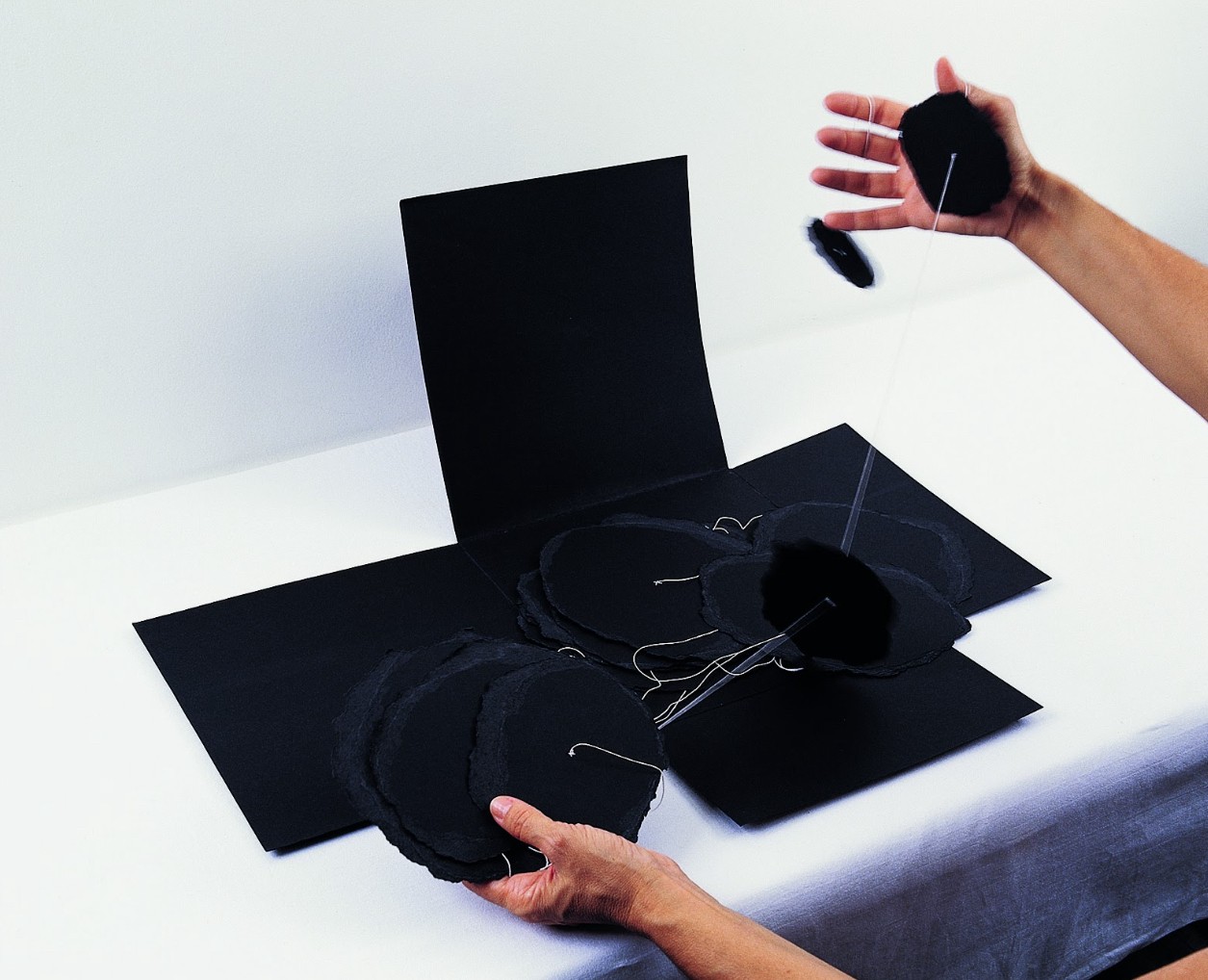
Source : Estudio Maiolino. These latter series led to Livro Objeto (Book Object), which again uses black paper and features layers of round sheets of various sizes, covered by four flaps in the shape of a cross. Displayed on a dark coffee table, the round sheets are bound together by a long white thread that, escaping the constraint of the cover, rises into the surrounding room until it reaches, and is affixed to, the ceiling. This is a book for contemplating the flight of black sheets of various sizes. A book for flight that makes its mobility visible. 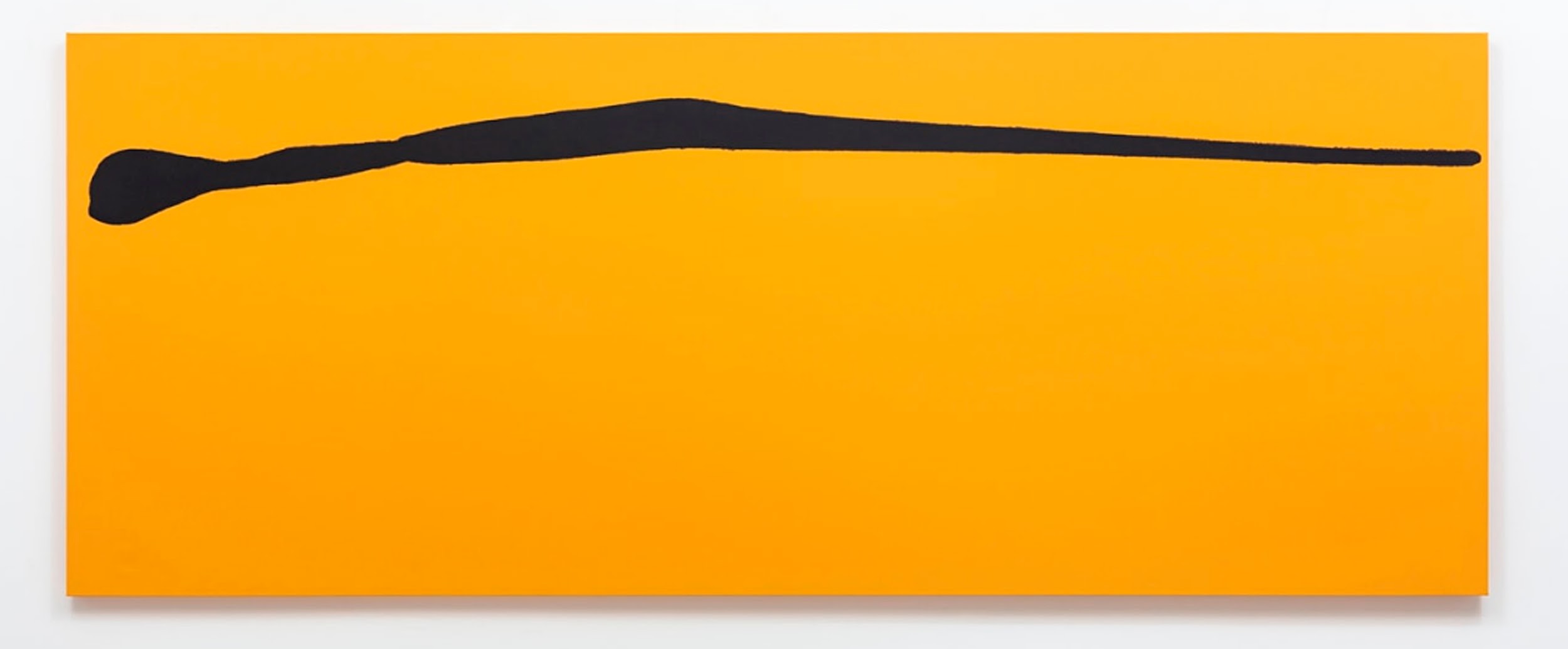
The striking thing about the works in the Ações Matéricas (Material Actions) series is the colour — something not very present elsewhere in Maiolino’s oeuvre. Against grounds backgrounds of orange-yellow and red, shapes in black acrylic ink are transformed into painting / drawings. The material properties of acrylic ink generate a play of forms, of chromaticity conjugated in yellow-orange-black and red-black-white. All these elements weave a pathway for a quest for meaning. But is this meaning somehow readable, or is it merely made present by the hanging of these pictures ? A readable representation (if it be) escapes us. It would require to establish a correspondence based on a communally shared convention that would permit some recognition between expression and content. But this is not the case. At the level of our perceptions, what comes first is the presence itself of these objects and their matter, whose meaning we grasp through the simple, direct, contact with these Ações Matéricas. The meaning is therefore not to be read but perceived, aesthesically seized, as confirmed by the fact that the artist hasn’t titled the diptych. The choice of not giving a verbal name is a strong marker. It means that in front of these Ações Matéricas, the spatial vision is the locus for a lived semiotic experience, a personal practice of sensemaking. In such works, for instance in front of this black ink that models, as it flows, a moving line across the support, the wall and, why not, the museum and the outside world, we are challenged to seek the plastic qualities that command a form of presence beyond the painting. The material presence of paper Through drawings, prints, embroidery, sewing, tearing and painting, Maiolino has demonstrated the specific porosity of this matter —paper — as well as the lightness of its woven framework. The only thing we cannot do is smell the odor of the paper, because, in delivering an example of her work, Maiolino places the product-object in a glass-covered frame, like a wooden casket. The artwork is Maiolino’s encounter with the paper (or, elsewhere, other materials), which she tears with her hands and agile arms, with her body’s dexterity, strength and movement — its weight, balance, and suppleness — which all give her the necessary stability to act on the paper’s woven texture. Her goal is to make its constitution visible through its resistance to the metal blade masterfully wielded by her hand and flaying fingers in her quest to discover the layered weave of the paper, allowing the intrinsic drawing to reveal itself. In order to give greater visibility to the materiality of the paper, Maiolino usually colors it, exposing the three-dimensionality hidden by the specific chromaticity of its apparent flatness. This chromatic ploy reveals marks of eidetic formants as well as the plastic characteristics of the constitution of paper, based on a layering of superimposed planes. We are thereby led to see what paper is made of. It is true that many people say they just see a bird in flight (or a loping animal) and they are right since the lines do form elements of content permitting the recognition of a correspondence to this kind of figures of the natural world. But by getting free of such symbolic conventions the beholder may realise that the cuts in the texture of the green paper display a different chromaticity contained in the layers of its weave. They reveal the matter’s interiority, spurring sensory organs to perceive the fine threads and fibers making up the paper with its weight, thickness, and porousness. They are not there to represent something external, but to show, to make palpable the materiality of paper. Its mode of presence is liberated once its tangible density becomes visible. This is a tale of material and its materiality, revealed through the simple fact of being perceived by an eye that sees by groping. As with Maiolino’s work on other materials, it is her intuitive gesture that enables us to sense the paper as manipulated by hands or sharp blades revealing its inner aesthesic properties. The art of unusual experiences of material Making matter visible and present in art is what Maiolino explores as a principle, a means and a goal in her dealings with the world around her. Her intention to awaken our senses to the plastic qualities of the various materials that make up objects — those products of constant experimentation — imparts visibility to what had been masked, hidden, non-visible. Through a great variety of materials Maiolino reinvigorates the aesthetics of art. The perceptual density of materials in her works incites us to grasp them in the transition from the tangible to the intelligible, from feeling to understanding. Illustrating a conception of art that stresses materials, Maiolino’s work startles the beholder. It leads to raising many questions, such as : Is the site of installation in the exhibition gallery a work of art in itself ? Should it be considered art itself ? And how to categorise such a site : visual art, spatial art, spatio-visual and kinetic art ? Among all these questions, the most troubling is the one that concerns the assumption of the very meaning of what has been created with matter. |
|
|
References Greimas, Algirdas J., De l’Imperfection, Périgueux, Fanlac, 1987. (tr. it., Dell’imperfezione, Palermo, Sellerio, 1988 ; tr. esp., De la imperfección, México, Fondo de Cultura Economica, 1990 ; tr. port., Da imperfeição, 2ª ed., Estação das Letras e Cores, 2017). Landowski, Eric, Presenças do outro, São Paulo, Perspectiva, 2002. — Com Greimas. Interações semióticas, São Paulo, Estação das Letras e das Cores, 2017. — Au risque du sens, São Paulo, Estação das Letras e das Cores, 2025. Oliveira, Ana Claudia de, “Sentidos do corpo, ou corpos sentidos ?” in I. Assis Silva (ed.), Corpo e Sentido. A escuta do sensível, São Paulo, UNESP, 1996. — “A dança das ordens sensoriais”, in R. Dorra et al., Semiótica, estesis, estética, São Paulo, EDUC, 1999. — , 4, 2002. — (ed.) Semiótica plástica, São Paulo, Hacker‐CPS, 2004. — (ed.) “Sentido e qualidades sensíveis — plásticas, rítmicas e estésicas”, in Sociossemiótica II sentido, estesia, gosto, São Paulo, Estação das Letras e Cores e Editorado CPS, 2021. |